Why is Your Audience So Scary?

English: Audience in the main hall of the Mobi...

English: Audience in the main hall of the MobileHCI 2008 conference. (Photo credit: Wikipedia)

How uncomfortable are you with your audience?

I have spent a large portion of my life in front of audiences as a musician, as an educator, as a speaker, and, going way back, as an actor (think “the class play in junior high school“…), so I have worked with and observed audiences in a lot of different ways and scenarios. If you read my blog regularly you might think that my concept of an audience versus some other social construct is a little lower than, say, a community.

Not really…

Continue reading

5 Superior Social Media Posts to Drive Your Business!

You want “The Short List.”

This list gives you the best information for your business, and let’s you understand what will make your digital and social media marketing work so you can get back to work. I have collected these 5 articles from around the web as the best of the best for October. Read them all, then figure out how you can execute on them, based on your goals and resources.

Ultimate Blog Post list

Ultimate Blog Post list

You’ve got a blog or intend to start one, but are REALLY intimidated by the idea of having to come up with posts every week (or however frequently you have decided to publish…). I scan this list regularly to jog my creative juices and come up with new ideas. This article is by Russ Henneberry of DigitalMarketer.com.

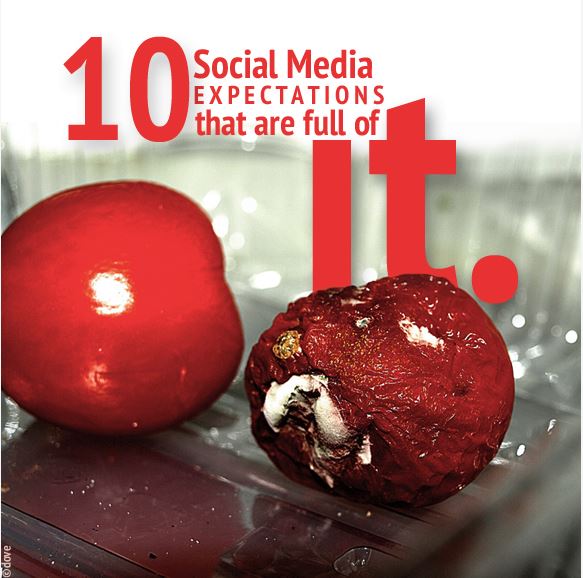
Social Media Expectations

Social Media Expectations

There are still a lot of entrepreneurs and small businesses that are guilty of “magical thinking” when it comes to what social media can accomplish for their businesses.
When you go searching around the web for ideas to improve your digital and social media marketing, you’re confronted with the same thing I am: a TON of information! You don’t have the time, the patience, or maybe even the depth of expertise or comfort in a lot of these areas to know who’s reliable or who’s just selling something. This article by Carol Stephen helps you stay grounded.

ROI cost-effectiveness

ROI cost-effectiveness

The acronym ROI (Return On Investment) is so easily bandied about that most of the time you think you know what it means, and you’re wrong. I learned so much by reading the works of K.D. Paine that I want you to become acquainted with her and her work. Most of the time, what you really want to know is the CEA (Cost-Effectiveness Analysis), which “compares the relative costs and outcomes (effects) of two or more courses of action.” This article will help you get the difference so you can figure it into your calculations for resources and costs.

Social Media and Competitors

Social Media and Competitors

If there really is “nothing new under the sun,” then it makes particular sense to check out what your competitors are doing (successfully and unsuccessfully…) on social media. This article by Matt Walker, CEO of Main Path Marketing, outlines some great tips and a good starting methodology to figure out how other companies’ social media strategies, altered to fit your business, can help you. Competitor research is something that a lot of small and medium businesses miss, and it can be a real gold mine.

Networks and Communities

Networks and Communities

Networks connect; communities care.” In this Harvard Business Review article, Henry Mintzberg, a professor of management studies at McGill University in Montreal, touches upon the roles of each kind of construct. In my business I work with clients to understand the opportunity and value of each kind of construct (network, audience, and community) and ensure that businesses approach them in ways that drive the greatest value. If you want to get a handle on the differences and challenges, this is a great place to start.

Get this kind of information more regularly and sign up for my Social Sapiens newsletter.

Want more? Like and Share the Social Sapiens Facebook page, sign up for Notifications under the Like button, and add us to your “See First in Your Newsfeed” group.

What is the Remarkable Power of a Daring Vision?

I’ve been thinking a lot about vision and goals lately. As the incoming president of my business networking chapter, I’ve been meeting with the outgoing leaders, my leadership team, our regional leadership, and other strong leaders and leadership coaches within the organization, as well as talking with other leaders (not to mention the guidance and advice available from so many in books and online….). I keep pulling back, looking for simplicity and clarity….an awareness of the possible while casting my thoughts wider to “Why?” and larger destinations and possibilities.

The idea of S.M.A.R.T. goals is pretty well known. As a review, S.M.A.R.T. stands for:

  • Specific – Goals should be simplistically written and clearly define what you’re going to do.
  • Measurable – Goals should be measurable. In this way you have tangible evidence that you’ve accomplished them. These can include the Big Goal measurement as well as measured milestones.
  • Achievable – Goals should stretch you slightly so you feel challenged, but defined well enough that you can actually achieve them.
  • Results-focused (or Relevant) – Goals should measure outcomes, not activities.
  • Time-bound – Goals should be linked to a time-frame of some kind that creates a practical sense of urgency, or results in tension between the current reality and the desired end-state. Keep in mind the Achievable aspect of the goal when setting the time-frame, of course.

Vision is a different kind of animal. Very different. Setting a goal for monthly sales or post engagement on Facebook for the quarter is not a vision. When building goals we tend to look at the recent past as a starting point and build on that (or, if starting something new, look at a similar process, product or business, try to extrapolate an “oranges to tangerines” comparison…not exact, but close enough…). Creating an effective vision means freeing myself from my existing reality and think broadly of possibilities and destinations. This is not “pie-in-the-sky” dreaming, but a deep look at an ideal future. Several writers I have come across lately use Dr. Martin Luther King‘s “I Have A Dream” speech as an example of visionary leadership. While his goals within that speech included a number of the steps that would be needed to make headway toward the vision, the vision was So Much Bigger. He described exactly what the American scene would look like when the full impact of his goals were felt and implemented. One famous section is:

“I have a dream that one day, down in Alabama, with its vicious racists, with its governor having his lips dripping with the words of interposition and nullification; one day right there in Alabama, little black boys and black girls will be able to join hands with little white boys and white girls as sisters and brothers.”

In your mind’s eye you can see what that looks like! It is so much more grand that the end points of a number of goals.

Goals may be ambitious by themselves. A big one mentioned by another writer was when President John F. Kennedy committed the country to placing a man on the moon and returning him by the end of the 1960s. Huge Goal! But what came after? Other than getting there and back again, what else was there? Hence the problem of coming up with a compelling vision for further space travel and exploration (although a number of futurists, respected scientists and writers try). There is, at present, no strong, heart-stirring vision for exploration and travel that we can, as a society, turn to and say, “That’s it! Let’s go!”

Apply this exercise to your business. When you sat down and created your business plan, you undoubtedly created goals, milestones, and outlined some measurable processes to reach those goals. But, speaking to your vision, why are you actually in business? What does your community, your industry, your world look like as a result of you having created this business, provided what you provide to your customers, and spent so much time and so many resources on its success?

Is your vision a “shining city on a hill”? You can make it so.

How to unlock your authentic and remarkable voice!

A spectrogram (0-5000 Hz) of the sentence &quo...

A spectrogram (0-5000 Hz) of the sentence “it’s all Greek to me” spoken by a female voice  (Photo credit: Wikipedia)

You have an untold number of things that make you different from the next person. Just ask your roommate, significant other, or neighbor!  You may feel, like I do sometimes, that you don’t have something truly unique to say.  Don’t get hung up on that.  Just say it better and say it your way.

Continue reading

Do Your Passions Make You More Human?

Signature of Richard P. Feynman

Signature of Richard P. Feynman (Photo credit: Wikipedia)

It is much too easy to burrow into your business and go deeper into the knowledge, building more depth and expertise in that area so you can be an even better resource for your customers. But doesn’t this turn you into a “one-trick pony”? For example, in my social media consulting business, does it truly broaden my mind and stretch my intellect to become more facile in the inner workings of Facebook and Content Marketing…or is it kind of “more of the same”?

I have other interests. You do, too. How do I indulge them, push the boundaries of my interests, and maybe even develop new ones? I need to consciously expose myself to knowledge I probably wouldn’t otherwise, and I have to set aside the time to do it. This is a challenge as an entrepreneur, but to not do it means that I’m less likely to keep growing intellectually, emotionally and spiritually. There is also a much higher probability that, in exploring some of these new landscapes, I might come across a couple of new ideas that inform and impact my business in ways I have no way of anticipating now.

So, where do I start?

Continue reading

How To Approach Fun Numbers and Shrewd Sizes

Here’s the deal: I don’t go onto the web to be sold to. I look for information. I look for content that will tell me something I don’t know and satisfies my curiosity. I want to be intrigued. I want to learn and join conversations.

Mostly, however, I want to have fun.

Continue reading

How To Be More Contagious

Consuming and sharing content normally creates an emotional benefit, not a financial one. Hence the obstacle: companies try to use content to create financial benefits for themselves instead of emotional benefits for their readers. This completely overturns the traditional business view of what content should accomplish.

Studies show we’re hard-wired to talk about ourselves. Around 50% of what people talk about on social is ‘me‘ focused, and it’s not just vanity (although there are an ENORMOUS number of selfies and/or pictures of the food in front of you out there, but I digress…). Harvard neuroscientists Jason Mitchell and Diana Tamir discovered that disclosing information about ourselves is intrinsically rewarding. They found that sharing personal opinions activates the same brain circuits that respond to rewards like food and money. So how do you climb aboard those conversations?

Continue reading

Why Does No One Share Your Sensational Content?

So, let me share an uncomfortable truth: generally, no one wants to share your content.

Research by Cornell University, HP Labs and EPFL shows that people typically don’t share content they read on the web, even “great” content. The vast majority are passive information consumers. For example, the average Twitter user retweets only 1 in 318 content links they receive. Facebook reports that just 0.5% of those who see a Facebook post share it.

Does this mean all your hard work to create terrific content is wasted? No…but it does suggest that actively finding and nurturing that minuscule number of the most active users is critical to spreading your information online. Popularity, the nature of the content, and audience size alone don’t predict that this passivity will be overcome and they will “click to share.” You must employ strategies to overcome this passivity and systematically find those predisposed to love and share the content you create.

Continue reading

Content Shock and the Search for Impact

So now you’ve done a bit of research and found that not only is your market saturated with content, but you’re up against some “heavy hitters”. Competition seems hopeless and you don’t see how you can make any real headway. Well, there are three tactics you can use that can provide you some leverage and opportunity. Continue reading

Is Innovation Dead?

Innovation” has become a flat buzz-word in business. I think we may have finally beat it into unremitting grayness, which is unfortunate. If ever we have been in need of creative and unusual solutions to problems, it is this moment in which we find ourselves. Even the concept of “disruptive innovation” has become something of a totem that has lost meaning.

I have been in discussions of how some organizations choose to approach this kind of process. Some pat themselves on the back if they can manage to agree on changing the color of the cloth covering the cubicles, and others destroy productivity and morale by nuking the team, process and business plan almost monthly. Certainly, what works for one may not work for another, but taking well-written best practices and lessons learned from an book or article (or motivational speaker…) and then rounding your team into a room and delivering it as this quarter’s way out of a business problem without due research and context probably won’t work.

Continue reading