See It All

I do a lot of varied reading through out the days and weeks. I just finished a book by Dr. Cornel West entitled “The American Evasion of Philosophy” and started one by Slavoj Zizek entitled “The Sublime Object of Ideology”.

Not exactly easy reads, but they are part of my ongoing desire to wrap my head around the philosophical, cultural, societal, spiritual, etc. foundations that not only surround us today, but brought us here (Lest you think I’m buried in this stuff, I’m also reading/listening to other books – War & Peace, Limit by Frank Schätzing, a History of Spain, Theology of the Old Testament by Walter Brueggemann, The Fabric of the Cosmos by Brian Greene, and a couple of others…..I like being able to switch gears as well as get exposed to the unpredictable ways all of these can shine different lights on each other).

As I read the early part of the book by Zizek, he mentioned a “progressive theorist of education” from the Sixties who published a study in which a group of children were asked to draw an image of themselves playing at home. A few years later, after some years in primary school, the same group of youngsters were asked to do it again. There was quite a difference. The early self-portraits were “exuberant, lively, full of colours, surrealistically playful…” The later portraits were much more subdued. Most of the group chose to use only regular pencils, although other colours and drawing pieces were available. Predictably, this experiment was taken “as proof of the ‘oppressiveness’ of the school apparatus, of how the drill and discipline of school squash children’s spontaneous creativity, and so on and so forth.” (Slavoj Zizek, The Sublime Object of Ideology, pg. ix)

While not entirely subscribing to this viewpoint, I began to think about the experience and perception of each of us, surrounding expectations regarding what we see, and a whole host of other influences, factors and limitations. I remember clearly, to my later shame, working with my kindergarten-age daughter to try and help her learn to color within the lines of work that she had from school. My goal was to try and help her be successful at school, without thinking about the joy of coloring outside the lines. She worked very hard to do this, which slowed her down considerably, thereby finding a different avenue from which to annoy her teacher (she later was told, in class, to just stop working at it so they could move onto the next thing on the classroom schedule…..She felt like such a failure…).

Visualize this process. Take this photo:

Graphic 1: Source unknown

A younger child, asked to draw this, gives you something like this:

Graphic 2: rendered by CoPilot

A few years later, upon being led into the world of “how a grown-up would do it”, the artist hands you this:

Graphic 2: rendered by CoPilot

From the vantage point of someone about to turn 70, I meditated on this conclusion by the educational theorist, my experience as a parent and member of our society and culture and years of life folding like layers upon my awareness. If the photo, as regards this writing, represents what I ACTUALLY see, then the two drawings are not an either/or perception……they are both/and and beyond.

The first drawing has, perhaps, more vibrancy and colorful impressions of the reality. The second, however, isn’t ‘wrong’. It observes a more Platonic ‘essence’ of the subject, with clarity and precision that the first one misses (although, to be fair, ability and the difficulty of working crayons when in youngster “Woo-Hoo!” mode can make clarity, etc. harder to capture….).

So, there’s more there. It is NOT a matter of one being Right and other being Wrong. Not only are they both Right, but there’s even more there to see. Throughout your day, sit with the moment and try to restrain your own ‘monkey mind’ concerning the things you see. Just take the grace and time to see them, accept them, and realize that others may see different things about them than you do, which isn’t wrong. Taken together, you may both be “right” with more to see together.

I’m feeling that I want to see what I see more in light of the first drawing. The colour, the life, the vibrancy lead me to a mindfulness I don’t access any other way.

The Whole Deal

Graphic by CoPilot AI

We human beings fall so very naturally into “either/or” thinking. Whatever I happen to be thinking about or experiencing, there always seems to be an “over-and-against” object to face or confront and either ignore, fight against, abhor, or try to change. This is true within as well as externally.

A LOT that I have read over the last number of years by any number of authors and resources discusses this problem and how to address it. Internally it can show up as a distaste (at least…) and sometimes hatred (many times…) of some aspect of who I am or things I have done, some of which I still do. Externally it shows up many, many ways and in differing degrees. Anywhere from a slight disgust or aversion to something or someone, to raging, blind hate and anger. However the so-called “Other” shows up in my experience or cognitive observation and classification (another thing humans excel at: classifying things and people to ensure we don’t have to work too hard at understanding them…..we HATE cognitive heavy-lifting, by and large). Those things inside me I work to change, lose, ignore or suppress.

Understanding myself as a whole person, encapsulating both light and shadow, is hard (and all of the degrees of grey…). It’s one of the main reasons why I have begun to appreciate the Taoist Yin-Yang symbol as a representation of the whole me. Another set of phrases, especially strong in my understanding of this truth, is settled in my memory by Richard Rohr. A quote of his that I have taped to my desk says, “The false self is not a bad self, it’s just not the true self.” The light and dark are both part of me, and I am totally loved, regardless. That, of course isn’t to say that I don’t endeavor to work for the enhancement and health of the light in myself, to the diminution of the shadow. But, I’m not working to cultivate the shadow, either.

A Journey of Gaps

Graphic by CoPilot AI

I keep reading, especially in the book I’m into about Sartre and his thought journey right now, of the unusual place of art in establishing a counter voice in times of upheaval and uncertain restraints. It’s hard for me, as I feel like I only have one or two drums to beat, and that I’ve whomped on them before, so what’s new there? I’m not sure….Perhaps the context of a new day or a different focus?

That said, I have friends who take part in various arts (music, visual, written) in regular and copious expression. I’m a bit envious of their compulsion/addiction to their artistry. But I know that I can’t compare myself to them. I can look at who I was yesterday and look at myself today. Moving this moment forward is the only change I get to really take part in, and life teaches me that THAT changeableness is the norm of Reality. Without being driven over by events, flexibility and openness to the call in that moment and the next is what I can pay attention to and live into and out of.

My real passion for the past 4 or so years has been to read and learn as much as I can. My personal library is enormous, and I’m guilty of only reading about 30+% of the books I purchased in my life (years ago I used to comb through book stores while I worked in the military or in corporate, telling myself that I was obtaining them for when I didn’t have the funds to buy them any more. Of course, being a true bibliophile, I always came up with fund for more books).

Then there’s the desire to reread those few works that call to me to be experienced again, for whatever reason. There may only be so much time between today and the day I will be unable to read or understand what I can take in, so I do my best to cover a lot of ground now. As the eyes give out, that is a challenge, although I am mightily grateful for audio books…..I only wish they also had more of the other books I have that haven’t been produced in audio yet, but it’s a good start.

Anyway, as I have studied more in the (somewhat overlapping) areas of linguistic theory, critical literature theory, theology and mysticism in a number of religions, cognitive science, psychology and communication, the histories of other cultures (and their global influence), and the kind of Zen-like qualities of quantum mechanics (I’m a science geek, but I don’t have the math and physics chops to go very deep there, still….it’s awfully cool!)…my initial question to myself when I started this particular journey was, and still is, “What brings us to this place in society today, and what can I better grasp in order be an intelligent and love/life-giving person in this world?”

That’s an inadequately expressed, shortened goal. There are any number of rabbit trails to head down in working toward filling in the gaps in my understanding, usually uncovering scores of new gaps as I go. I’ll pass on some of the stuff I find out about, if it seems like it might interest you as much as it does me.

Weasel Words

I have been using a term, “weasel word”, in a way that has garnered a bit of attention and enough misunderstanding that I think I need to clarify my particular meaning.


First of all, in my most common usage, a weasel word is not a bad word. (A further definition, if you wish to read more about this term, can be found here…) Weasels have an occasional cultural and semantic reputation of being an animal to avoid. That is not the attribute I want to emphasize when I use this term in the context of clarity and further understanding in a conversation. I am more focused on the slipperiness and cunning of the animal. When I say or write “weasel word”, I imply that the word is hyper-subjective…. Slippery, if you will. There are any number of words that are NOT weasel words, if only because they are slightly better established in the commonality in our experience.


For example, if you say the word “cow”, I may not visualize the exact same animal you do, but somewhere in our experiences, whether Real Life experiences or exposure via the media in some way, initially we both know, at a basic level, the kind of animal we’re talking about (certainly, if the conversation is about cows and not just a passing reference, further definition may be desired….). This is more of a problem when words that are indicative of a concept or a belief, especially when utilized to persuade or convince, but can easily show up in daily conversation. Here are a few examples:

  • liberty
  • justice
  • law
  • love
  • illegal
  • constitution
  • evil
  • good
  • diversity
  • strong
  • weak

…and so on. In the context of a real conversation between people who wish to understand each other, if and when words like these come up (or any other words that make a person “jump up” internally and make them either uncomfortable or immovably established in their “solid” idea of what it means…), time needs to be taken to ask about what each other means and feels about the word or words, and listen. Even if the person doesn’t agree with the other’s definition, at the very least you can know what the other means when using that word or those words, and will make the conversation more productive. The chances of a slight re-think of your own definition may occur.


This whole ongoing process of noting and dealing with weasel words in our discourse, whether at home or in public in some way, can make you less likely to be easily manipulated by any person or organization trying to force you to react in some way. Work well worth doing.

Being: Salt

“You are the salt of the earth; but if salt has lost its taste, how can its saltiness be restored? It is no longer good for anything, but is thrown out and trampled under foot.” – Matthew 5: 13 (NRSV)

For quite some time now I have been fascinated with incorporating “being” in my life and awareness. This hasn’t been easy, nor is it ever “done.” (I know I’m using quotation marks a lot here, but bear with me…)

A term and concept that has gained a lot of attention is mindfulness. This is an aspect of being that I include in my dialogues, but my growing understanding and experience of being (I’m dropping the quotation marks for that word at this point…) is only part of it.

Mindfulness, to me, is being fully aware of the moment in which I reside, at any given moment. It implies a certain kind of attention that is neither cast backward nor forward. One way of looking at how I apprehend being at this time is kind of mindfulness without the attention. Let me explain further….

Continue reading

Mindfulness and Taking Stock

Mindfulness

Mindfulness

This past week was a good and difficult one.
One of the hard bits was working to get five + days of work done in three, as I had scheduled Thursday and Friday off to celebrate my anniversary and birthday. I work to do this every year and have been pretty successful to date, although banishing work from my mind is always a challenge as an entrepreneur. Still, it was good to get away from the screens and focus on each day and the moments each held, along with the commemoration activities.
I focus on this set of events for a couple of reasons.
First, I wish to celebrate life and relationships, and this is another way to mark them as memorable and life-giving.
Second, this particular birthday gives me pause. I am now the age my father was when he was consumed by cancer and died. That, along with the near approaching anniversary of the death of my younger brother in two weeks, I am particularly aware of being present in each moment and how this manifests itself in my “normal activities”…..”normal activities” being the usual, rather mundane things of every day.
You may be thinking (if you’ve read this far..), “Why is he writing about this on a business blog?” A fair question…

Continue reading

If You Read One Article About Ideas, Read This One!

BOOKS: Ideas Bound

BOOKS: Ideas Bound

I have long had the habit of reading more than a book at a time…

Since the advent of the Amazon Kindle, however, this has become something that is second nature. I don’t think it odd, and, with the ready access to who-knows-how-many books and samples I carry around, it just “is”! Much lighter, and a bit easier to keep track of where I am in each one….

This has allowed an enhanced creative journey for me. I read several kinds of books, according to my mood and focus…right now I am in the midst of:
…along with a couple of physical books (I have an enormous number of them that I either haven’t read yet, or return to regularly…):

Your Job and Your ONE THING

Job

The Job

“It’s not just a Job….It’s an Adventure!”

That was a marketing tag line for the U.S. Navy a number of years ago. A frequent comment among my fellow sailors at the time was “Is this the job part or the adventure part?”

The whole of these two concepts came up to me recently in a conversation I had with a mentor of mine. We were going over his long career, and he mentioned that he felt he never really had a JOB. I asked him what he meant, and he shared that his idea of a job was something that you pretty much had to drag yourself to, every day, like it or not. There was not much life in it, and any correlation between it and the conviction that he was doing something good, right, and worthwhile was nonexistent, or, at best, extremely minimal. He felt that all that he had done never went to the level of being a JOB for him.

After about four hours of dialogue and catching up (I hadn’t seen him for over 4 years…), I drove away mulling over this idea.

Did I ever have a JOB, by this definition?

Continue reading

What Are You Really All About?

[fusion_builder_container hundred_percent=”yes” overflow=”visible”][fusion_builder_row][fusion_builder_column type=”1_1″ background_position=”left top” background_color=”” border_size=”” border_color=”” border_style=”solid” spacing=”yes” background_image=”” background_repeat=”no-repeat” padding=”” margin_top=”0px” margin_bottom=”0px” class=”” id=”” animation_type=”” animation_speed=”0.3″ animation_direction=”left” hide_on_mobile=”no” center_content=”no” min_height=”none”]

blind men and elephant

The blind men and the elephant

Remember the old fable about the blind men and the elephant? Each one of them touched a different part of the animal and conjured up a description of it that was wildly different from the others’, based on their personal experience.

Stay with me….

I have had an experience like this with my business recently. Instead of being blind, though, it’s more like I was up-close-and-personal with my section of the elephant. All I could see clearly was the bit right in front of me. In my desire to really get a good look at where I am and where I’m going, I tried stepping back a bit, but really only got a wider view of the broadside of the elephant, though. I needed to back WAAAAAAAY up to really see it as an elephant….er, as my business.

I am fortunate. I just got back from almost two weeks’ worth of vacation on a lovely tropical island. Lots of beach time, lots of “spare room” for my mind to unwind, and little to no “screen time” to distract me (THAT was nice!). It took most of the vacation for my mind, at all levels, to unwind and back-off enough to not only see the elephant, but discern if this was the elephant I wanted and have been working for / toward for years.

This is humbling, and an eye-opener…

One consideration I confronted was “What do I consider success?” This is a tougher-than-you’d-think question. It is beyond revenue, recognition, client-lists, board and committee memberships, or mission statements. It is “What am I about?” and “Why do I do this…..really?

This requires me to go deeper into my reason for being. If I truly believe the importance of mindfulness and the present moment, this must be reflected by my business. As a consultant (which holds for any small business owner…), I really AM my business. So, again, what am I about?

Continue reading

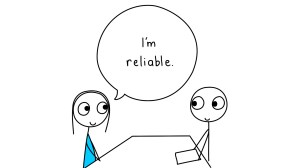
FOCUS: Of Course You’re Reliable! RIGHT??

Are you Reliable?

Are you Reliable?

The far end of reliability is taking things for granted, right?

You hop in your car, perform some kind of ignition action, and you just EXPECT the car to start up so you can go do what you need to do. You head into the barbershop or salon you’ve been frequenting for awhile, sit down for some kind of hair-related operation (maybe with the same barber or stylist you’ve been seeing the whole time…) and EXPECT to look a certain way when you leave. You flip a light switch in your living room and you EXPECT a light of some sort to go on.

It’s when you perform these actions and what you expected DOESN’T happen that you become intensely aware of reliability.

Each of these examples involves an inanimate object, but the same expectations and certainty are what define reliability in relationships as you build trust. In his book on trust, Charles Feltman defines reliability as “the assessment that you meet the commitments you make, that you keep your promises.” You make commitments in two ways: in response to someone else’s request (or, if they’re higher up the food chain than you are, it might be a direction or command…) OR by making an offer to someone. When the other persons accepts your offer they usually consider it a commitment on your part.

Requests can be the problem. Crystal clear communication is crucial here, because if you don’t have all the information you need AND you walk away with the request, the requester will assume you’ve committed to do exactly what they asked…..only you won’t be clear on the specifics, so you chances of success are, shall we say, variable. Sadly, many requests are the only-slightly-less-generic version “go do stuff with that thing and get back to me whenever…”

YIKES!
Feltman writes that you can increase real reliability through what he calls The Cycle of Commitment – basic elements that make for clear, complete, and direct requests:

  • CUSTOMER – Who’s doing the asking here? Who’s the request actually FOR? Never assume anything that looks obvious, here. When someone says something like, “We need to do some research on this” you desperately need to know who the research is for, so you can get to specific expectations about the research and also know to whom you go for further clarification or if you have concerns.
  • PERFORMER – Who’s going to do the work? Is it you? Are you qualified? Do you have the resources (time, talent, funds…) to fulfill the request? Is that clear to you AND to the requester?
  • ACTION – Just what EXACTLY does the customer want you to do? Can you actually do it? What measurements for the action or deliverables will be the outcomes of this action?
  • TIMEFRAME – When does the customer want it to be completed….Oh, and ASAP is not at all helpful.  Get a solid date, since ASAP may mean by the end of the week to you and by the end of the day to the customer.
Make sure you have complete clarity on each of these elements and your chance at success AND demonstrated reliability are significantly enhanced.

So, that’s what it looks like when others are making requests of you, but how can you help others by making your requests more effective?

Be Direct. Direct requests have a much better chance of clarity than indirect requests. Many people often “soften” their requests (making them indirect in a way…) because they feel that direct requests are impolite in some way. Granted, different cultures have different standards and mores surrounding the acceptable kinds of language used in making direct requests, so you need to be aware of that factor, however, what appears to work best in what I will call “typical” European and North American cultures, what seems to work best include the phrases:
  • I ask that you…
  • I request
  • Will you (please)…
  • (Please) do this….
 Less direct request, which are less clear and therefore less direct, include the phrases:
  • I want or I need…
  • Why don’t you…
  • …needs to be done.
 None of these is a real request, but most understand the intention.

Ridiculously indirect requests, which are usually not even perceived as requests, can include phrases like:
  • My coffee cup is empty. (Secret request: Get me more coffee.)
  • The conference room is a disaster. (Secret request: Clean up the conference room.)
  • It’s almost eleven o’clock. (Secret request: Get me the printed slides for the 11:00 team meeting.)
See how helpful being very indirect ISN’T?!

Of course, how you respond to a request is just as important as getting the request right if you’re demonstrating reliability. Once the Customer makes the request, the Performer (you, in this case…) need to respond. Here are the possible responses:

  • COMMIT – “Yes, I’ll do it.” To them this means, “I will do exactly what you’ve asked me to do. Here is where real clarity about the request is critical. If the request is vague or missing information, it is up to you to ask for it.
  • DECLINE – “No, I can’t (or won’t) do it.” This let’s the customer that you aren’t available to do whatever she’s requesting…..she needs to find a different resource. Sadly, in the workplace, many times “No” isn’t an option….however, saying “Yes” is truly setting yourself up for failure, so consider how “No” could be framed.
  • COUNTEROFFER – “I can’t do that, but instead I can do…” This is one way “No” in the workplace could be framed. Create something that MIGHT work. A counteroffer opens a negotiation scenario between you and the customer. This should end in either a commitment or a declination. Leaving things hanging in midair is the same as failure.
  • COMMIT-TO-COMMIT – “I need to check on something (resources, time, etc.) before I can get you an answer. I’ll get back to you by…” You might need more information. Regardless of the reason, be sure to designate a time at which they WILL get a firm answer.
Lastly, there’s the old favorite, the Drive-By Request. Seen mostly in offices, this type of request is the most easily tossed-off and the most likely to fail.

I remember vividly chasing my manager down the hall pleading for more information and clarification as she receded into a conference room and shut the door. As many of these requests are, it was a “short-fuse” request and I could either wait for her to return to her office AND lose precious time, or get hot on the request and HOPE that I hit at least SOME of the actual target. I usually did the latter and paid for it painfully. So, You can live with the stress of unclear deliverables or the stress of waiting for clarification so that success will be more likely. If possible, get together with this customer and go over the Cycle of Commitment with her…..for example, ask her not to assume “Yes” to a Drive-By request. Instead, she should give you a chance to respond to the request and get all the particulars. Everyone involved is much more likely to be happy with the result.

So here are some ways build your reputation of reliability:

  • Make sure you can actually do what is asked of you BEFORE you respond to a request.
  • If the request is unclear, ask for clarification and any missing bits of information.
  • If you are offering to do something, be sure they understand what you CAN and CANNOT do.
  • Listen to people to determine if they are making EXTREMELY indirect requests of you. Are they just talking, or are they creating a framework of expectations that are clear to them and vague to you? Decide which it is, and respond.
Reliability is more than just consistency. I know people who consistently make questionable choices…..that’s not the kind of reliable I’m looking for!