The Catnip of Storytelling

It’s the time of year when some of the people you haven’t seen or heard from for awhile may reach out to get together or call or chat or send massive tomes as “Christmas Letters.” (Folks still write those, sometimes, it’s true….) I have a few folks for which this holds true, but there are a couple of old friends I’ve referred to in other posts that get together pretty regularly. We don’t run out of things to talk about, for sure. Aside from the usual catch-up, we have all these intervening years during which we didn’t really keep in touch, plus our shared youths, to consider and reconsider.

Add to this that all three of us are born storytellers, and you have the recipe for a lot of Really Long and Fascinating Conversations.

Graphic provided by CoPilot AI

What is it about telling stories versus just conveying events or facts that is so compelling to so many of us (and drives so many other people utterly bonkers….)? I feel there are several different things, some or all of which call to our story-telling breed inexorably. Some of them include:

  • The desire to provide context. The presentation of a simple data point begs (to me..) to place it in what I deduce as a position of context that provides a bit of understanding about what that data point can mean in the environment around it. While most data gets some kind of context, storytellers prefer to give it a LOT of context! This, however, doesn’t play well with the Severe PowerPoint set…..
  • Like begets like. When surrounded by other storytellers telling stories, it only feels natural to “fall into the pool” and do like likewise. It is a very comforting a life-giving place to be…
  • The story triggers vivid, irresistible memories.  These make it difficult to break off or wrap up the story. If well-told, your hearers are drawn along with you. Eventually you realize that you’ve been holding forth for quite awhile and wrap up the current discourse (I have been know to say, out loud “I need to stop talking now….“). This at least gives everyone a time to sit with the memories, or for another one of your storyteller friends to tee up one of their own.
  • Storytelling used to be how we conveyed knowledge, experience  and belief. Humankind didn’t always know how to write, or read, or anything like that. Verbal was the only way ANYTHING was passed on, and stories lend themselves easily to memory. So, we’re kind of built for it……

Each of those sits atop the next for someone like me. When I was busy working on my graduate degree, my wife (a Ph.D. scientist!) would read my work and come back to me with two primary kinds of feedback:

  • Help with my written grammar – I tend to write conversationally.
  • A single question: “What is your point here?”

The assistance was invaluable to me, both for the degree and in the following years. The single question she asked has served me well over time until retirement from the corporate world, and serves me well now when I find myself involved in situations that require me to tell a little less story with the conversation.

Nonetheless, storytelling is truly catnip for me (at least as defined as what catnip is to a cat with a serious catnip problem….I have a number of cats, so I know what that’s like….). I don’t know how much of a draw it is to others. I feel that some are more drawn to written storytelling (I have a few friends who are authors, and I see this in them), others to face-to-face conversation (enticing, plus there’s body language to express and observe….), and, thanks to all the story-telling technologies and platforms available now, many more who tell these stories in a lot of ways.

If you are a member of this tribe, leave a note in the comments with a pointer to where we can find and enjoy your stories!

Mind The Gap(s)

The longer I live and the more avenues we all have to “converse” with each other or to the broad public arena, the more I feel like language ties us up. It can feel like going out into the woods and going “Boo-ge-da, Boo-ge-da!” to the trees.

Language is so part and parcel of our experience, each of which is singular and unique, that crafting communication to clarity seems harder and harder. Here’s an example I like to use:

Let’s say that I sit down with a new acquaintance and she tells me that she has two dogs. Here are the two dogs that I visualize:

Credit: https://pixnio.com/fauna-animals/dogs/two-puppies-dogs

However, here are the two dogs she loves and cares for:

Credit: https://commons.wikimedia.org/wiki/File:Great_dane.jpg

…and…

Credit: https://www.pickpik.com/chihuahua-dog-puppy-baby-play-young-108669

Now, as we continue to get to know each other, and as often as the subject of her dogs comes up in our chatting, I may gain a better idea of what her dogs are really like. However, my first internal impression is still there, even if it starts to evolve to a closer view of the truth.

If this is any indication of how something as basic as “dog” can get misinterpreted, here are a few words that have even greater latitude in interpretation and personal/cultural definitions:

  • Work
  • Freedom
  • Family
  • Father
  • Mother
  • Boss
  • Dangerous
  • Sickness
  • Rich
  • Poor
  • God
  • Socialist
  • Fascist
  • Vote
  • Neighbor
  • Home
  • City/Town
  • Country (meaning either Nation or Rural)

….and so on. Needless to say, any one of these words and concepts can drive a terrific conversation. A number of years ago, well before I received my Master of Communication from the University of Washington, I grew fascinated by how humans communicate, manipulate, and shape discussion. Since then I’ve nurtured my deepening fascination for quantum science, philosophy, and theology.

These all inform each other. I keep uncovering what I feel are really cool cross-meanings and enlightening points of view that help me to further my journey. I will never understand it all (especially the quantum science, but a deep bow is due to Brian Greene and his books….they lead me through the quantum briar patch better than most….).

The “Gaps” I refer to in the title to this post are the gaps in clarity and understanding that we, as humans, ignore at our peril. I deeply believe that part of the course we need to navigate in this world, and especially here in the United States, is one of “Minding the Gap(s)” in the understanding and empathy with all the members of our community.

“Holy Crap!” you might rightly exclaim. “That’s not a cognitive stance I can take with everyone!!!”

Well, no, probably not. It’s hard work and tends to take more time in an interchange than our rushed and breathless lives will allow. So, start small…start with someone close to you, that you interact with most every day.

In many ways, this will be a harder task, because, if you really are with them a lot every day, you’re used to a lot of conversational assumptions, which is pretty normal. There are, so to say, more gaps to mind. So, if you need to, choose another person. Listen in an open way, not busy composing what you will say or reply in return while you “listen”. Again, not easy, as it isn’t part of what we do naturally as humans, and certainly not part of your normal discourse, but give it a shot. Listen openly……ask clarifying questions (“HOW BIG is your first dog? WOW!!!”). Listen to the tone of her voice. Pay attention to facial expressions and body language (tough to do online, for sure, hence our challenges communicating there…more on that at a later time).

Each gap you mind will uncover additional gaps, for sure. Just going deeper with one person is a lifetime process. Broadening the effort to others will clear and uncover immeasurable other gaps. It’s all good. You’re deepening your relationships with those around you and gaining an understanding and empathy you can’t get any other way.

So, if you’re always trying figure out what’s going on, this can be an important part of the journey for you. It has been for me, so far….

Forward Into The Past

Cartoon rendered by CoPilot AI

It can sometimes take a long time for the technologies that I’ve gotten used to and the other threads of my life to get entangled in a more meaningful way.

OK, so some background story should be filled in here.

It has been a LONG time since I left home to join the U.S. Navy Music program back in 1973. While not a strict introvert, my close friends at home were small in number. We all pretty much went our own ways when time sprung us from home. That’s the apparent effect that many of us experience once we’re past the high school graduation experience. Being young, and having been around each other so much, “staying in touch” wasn’t so much in our DNA as much as going out to get hip-deep into life, whatever that was going to be for each of us.

Still over the years, there have been a couple of friends that I have stayed in very infrequent touch with. Over the decades we stayed vaguely aware of where each other was geographically and the status of our families (I was always WAY behind in keeping track of their children and what they were doing, but I was having a hard time keeping up with them personally and getting through everyday life, as I’m sure they were to.) Every once in awhile (like every few years…) we might have an impromptu phone call or a “drive-by ” visit, but generally life rolled on.

The rise of the kind of video calling that tech has brought into mainstream awareness and usage in the past several years, as well as personal advancing years, made me even more aware of what kind of regular get-together might be put together. At the beginning of this year, one of my friends lost his loving wife to heart disease (and the host of maladies that brings with it….). My other friend that I had kept in closer touch with had experienced a messy divorce a number of years earlier. All three of us seemed pretty comfortable with the online video tech, so I orchestrated a 3-way chat to catch up. I didn’t really understand the importance of this at the time…

We all like to talk and tell stories, which meant that I needed to block an entire afternoon for the chat, but that was fine. Being retired, my time (and theirs) was flexible, and it would be really good to be able to reacquaint each of us to the other in this context. The time spent was richer and more meaningful than I thought possible. We each came away from the chat hungry for more time together.

Since then we have gathered a least once a month. Other one-on-one chats spawned from the group chats, as we check up on each other. Rekindling these friendships has been one of the truly bright spots of this year for me, and one that I feel we have found to be valuable past valuing. I have rediscovered two extremely unique men that I valued highly long ago, and value even more now, if that’s possible. Lifetimes of experience, along with insights of life from the different parts of the country we live (I live in the Pacific Northwest, another lives in the Midwest, and the other on the Southern East Coast), along with finding out how well, or badly, we remember events from our past…..all these things, along with the joy that comes from experiencing afresh why we all became friends to begin with so may years ago….I can’t recommend it high enough.

If you have a friend that lives afar, either in time or space (or both…), and you haven’t caught up in awhile, do that. As humans, we are made for relationships, and building or rebuilding them is a good thing.

The Line

I pretty much get the moves that the ELCA (Evangelical Lutheran Church of America) makes to recognize the marginalized and the discriminated-against in our community and culture. Author and Shaman Lenny Duncan made that really clear in his Dear Church book, and certainly in his posted experiences in the past several years.


So when it was announced from the pulpit this past Sunday that our church was going to eliminate and/or limit the use of the words “Lord” and “Master” from service as they are reportedly offensive to (especially) Black members of our community, it jumped out at me. They (the words) hearken back to the deferential words and attitudes that slaves had to display to their owners. I can really see the tie-in.


But this bugged me for some reason. The study I have done on language and the history of certain words used a lot in the Bible presents me with a bit of a dilemma. As I understand the etymology of the word Lord, the Hebrew Bible uses this word in place of the Name of God, as it was not allowed to pronounce it (or even to write it, depending on how strict you wanted to be in the interpretation). A number of Christian writers, thinkers, theologians and teachers have chosen to use Lord instead of the Name of God in respect for the Hebrew traditions and their Jewish colleagues beliefs.

This is where the cultural context of language gets sticky. In the process of abstracting or obfuscating the word Lord from community liturgical use, what might this signal to our Jewish community, especially given the rise in anti-Semitic language and attitudes throughout the West of late? There is also another cultural challenge: Lord is a key word, and more importantly concept, for many Christians in their own spiritual lives. While the abstraction and excising of the Lord from the liturgy may address the discomfort of a segment of the community and acknowledge a past that is despicable, it denies the depth of integration of a particular, somewhat different meaning of the word into the devotional lives of others.


Where is the line? At what point is love, understanding and compassion flowing both directions? And there are So Many discriminated groups within our culture…..in a discussion I had about these questions, it was pointed out to me that, among many others, women are a discriminated class. Despite much having been done over the past number of years in opening up ministry, authority, and inclusive language, is it “enough”? What does “enough” even mean? Positive steps have and are being taken, but is our culture putting those efforts on pause, slowing them down, backing up, or what?

Other groups of community members with “invisible disabilities”, such as neuro-divergent people or those suffering from chronic pain, present different and difficult challenges to the caring people around them. How are the church and community seeing, prioritizing or addressing them in the context of the liturgy, their spiritual lives and day-to-day well-being?


Where is the line? That’s a really good question. Should there be a line? Ideally, no. Inclusiveness, by definition, means including everyone. Partitioning people into different groups, while helpful in ministering to needs, contains the danger of walling people from each other, and unconsciously prioritizing one group over against another. This is not the way that Jesus ministered, that I can read. He said that he came first to the flock of Israel, and then would turn around and heal and/or minister to Gentiles. For example, the demoniac of Gerasene was quite obviously in the Gentile world (why else would there be keepers of an enormous herd of pigs right there?!). Yet He cast the Legion of demons from this guy and sent him to witness to what God had done for him. No apparent line in His ministry that I can see there.


What can this mean for our actions within today’s world? I don’t think I can give any kind of definitive answer, other than to draw attention to The Line and encourage us to consider its meaning both in a liturgical and day-to-day apprehension.


The Line is there. Do we do anything with it?

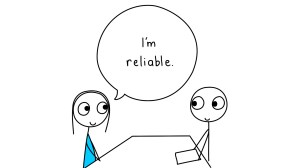
FOCUS: Of Course You’re Reliable! RIGHT??

Are you Reliable?

Are you Reliable?

The far end of reliability is taking things for granted, right?

You hop in your car, perform some kind of ignition action, and you just EXPECT the car to start up so you can go do what you need to do. You head into the barbershop or salon you’ve been frequenting for awhile, sit down for some kind of hair-related operation (maybe with the same barber or stylist you’ve been seeing the whole time…) and EXPECT to look a certain way when you leave. You flip a light switch in your living room and you EXPECT a light of some sort to go on.

It’s when you perform these actions and what you expected DOESN’T happen that you become intensely aware of reliability.

Each of these examples involves an inanimate object, but the same expectations and certainty are what define reliability in relationships as you build trust. In his book on trust, Charles Feltman defines reliability as “the assessment that you meet the commitments you make, that you keep your promises.” You make commitments in two ways: in response to someone else’s request (or, if they’re higher up the food chain than you are, it might be a direction or command…) OR by making an offer to someone. When the other persons accepts your offer they usually consider it a commitment on your part.

Requests can be the problem. Crystal clear communication is crucial here, because if you don’t have all the information you need AND you walk away with the request, the requester will assume you’ve committed to do exactly what they asked…..only you won’t be clear on the specifics, so you chances of success are, shall we say, variable. Sadly, many requests are the only-slightly-less-generic version “go do stuff with that thing and get back to me whenever…”

YIKES!
Feltman writes that you can increase real reliability through what he calls The Cycle of Commitment – basic elements that make for clear, complete, and direct requests:

  • CUSTOMER – Who’s doing the asking here? Who’s the request actually FOR? Never assume anything that looks obvious, here. When someone says something like, “We need to do some research on this” you desperately need to know who the research is for, so you can get to specific expectations about the research and also know to whom you go for further clarification or if you have concerns.
  • PERFORMER – Who’s going to do the work? Is it you? Are you qualified? Do you have the resources (time, talent, funds…) to fulfill the request? Is that clear to you AND to the requester?
  • ACTION – Just what EXACTLY does the customer want you to do? Can you actually do it? What measurements for the action or deliverables will be the outcomes of this action?
  • TIMEFRAME – When does the customer want it to be completed….Oh, and ASAP is not at all helpful.  Get a solid date, since ASAP may mean by the end of the week to you and by the end of the day to the customer.
Make sure you have complete clarity on each of these elements and your chance at success AND demonstrated reliability are significantly enhanced.

So, that’s what it looks like when others are making requests of you, but how can you help others by making your requests more effective?

Be Direct. Direct requests have a much better chance of clarity than indirect requests. Many people often “soften” their requests (making them indirect in a way…) because they feel that direct requests are impolite in some way. Granted, different cultures have different standards and mores surrounding the acceptable kinds of language used in making direct requests, so you need to be aware of that factor, however, what appears to work best in what I will call “typical” European and North American cultures, what seems to work best include the phrases:
  • I ask that you…
  • I request
  • Will you (please)…
  • (Please) do this….
 Less direct request, which are less clear and therefore less direct, include the phrases:
  • I want or I need…
  • Why don’t you…
  • …needs to be done.
 None of these is a real request, but most understand the intention.

Ridiculously indirect requests, which are usually not even perceived as requests, can include phrases like:
  • My coffee cup is empty. (Secret request: Get me more coffee.)
  • The conference room is a disaster. (Secret request: Clean up the conference room.)
  • It’s almost eleven o’clock. (Secret request: Get me the printed slides for the 11:00 team meeting.)
See how helpful being very indirect ISN’T?!

Of course, how you respond to a request is just as important as getting the request right if you’re demonstrating reliability. Once the Customer makes the request, the Performer (you, in this case…) need to respond. Here are the possible responses:

  • COMMIT – “Yes, I’ll do it.” To them this means, “I will do exactly what you’ve asked me to do. Here is where real clarity about the request is critical. If the request is vague or missing information, it is up to you to ask for it.
  • DECLINE – “No, I can’t (or won’t) do it.” This let’s the customer that you aren’t available to do whatever she’s requesting…..she needs to find a different resource. Sadly, in the workplace, many times “No” isn’t an option….however, saying “Yes” is truly setting yourself up for failure, so consider how “No” could be framed.
  • COUNTEROFFER – “I can’t do that, but instead I can do…” This is one way “No” in the workplace could be framed. Create something that MIGHT work. A counteroffer opens a negotiation scenario between you and the customer. This should end in either a commitment or a declination. Leaving things hanging in midair is the same as failure.
  • COMMIT-TO-COMMIT – “I need to check on something (resources, time, etc.) before I can get you an answer. I’ll get back to you by…” You might need more information. Regardless of the reason, be sure to designate a time at which they WILL get a firm answer.
Lastly, there’s the old favorite, the Drive-By Request. Seen mostly in offices, this type of request is the most easily tossed-off and the most likely to fail.

I remember vividly chasing my manager down the hall pleading for more information and clarification as she receded into a conference room and shut the door. As many of these requests are, it was a “short-fuse” request and I could either wait for her to return to her office AND lose precious time, or get hot on the request and HOPE that I hit at least SOME of the actual target. I usually did the latter and paid for it painfully. So, You can live with the stress of unclear deliverables or the stress of waiting for clarification so that success will be more likely. If possible, get together with this customer and go over the Cycle of Commitment with her…..for example, ask her not to assume “Yes” to a Drive-By request. Instead, she should give you a chance to respond to the request and get all the particulars. Everyone involved is much more likely to be happy with the result.

So here are some ways build your reputation of reliability:

  • Make sure you can actually do what is asked of you BEFORE you respond to a request.
  • If the request is unclear, ask for clarification and any missing bits of information.
  • If you are offering to do something, be sure they understand what you CAN and CANNOT do.
  • Listen to people to determine if they are making EXTREMELY indirect requests of you. Are they just talking, or are they creating a framework of expectations that are clear to them and vague to you? Decide which it is, and respond.
Reliability is more than just consistency. I know people who consistently make questionable choices…..that’s not the kind of reliable I’m looking for!

FOCUS: Are They Twist Ties or Trust Ties?

Trust

Trust is more than a High Five!

Building trust is vital and required.
If you aren’t found to be trustworthy, that pretty much puts the end to having the kind of impact you want to have, whether personally or in business. While the same goes for those around you, you are the only one that can work on your own trustworthiness.

This week I read another mind-provoking article by Valeria Maltoni entitled “What Do We Do About Trust?”.  This led me to get a copy of a book mentioned in the article, The Thin Book of Trust by Charles Feltman, which I devoured in a couple hours. If you have a couple of hours (plane trip, hot afternoon on the patio, etc.) I recommend this. It is relatively short, very well written and focused on the topic in a way that you can absorb and use.

I am utterly fascinated by all of the relationship, network, cognitive and behavioral topics that surround us as human beings in our society and how they influence and guide our businesses and personal lives. Whether psychological studies into why we act the ways we do as they apply and “infect” other areas of study (like Behavioral Economics…how this influences how we actually make choices, both as business owners and consumers, and being aware of the WHY of these actions), to the kinds of thought and work that can make your business more effective, including marketing, VACC (Visitors/Audience/Customers/Community) and content research/strategies, along with the kinds of cognitive bias that keep us from being as successful and happy (…frankly…) as we can be. Much like the world of physics crawling toward The Grand Unifying Theory of Everything (not to be confused with the Answer to the Ultimate Question of Life, the Universe, and Everything…), I feel there are a lot of overlaps and supporting science and studies that lead to A Grand Unifying Theory of How We Actually Think and Get Along.

Continue reading

GO DEEP: Strong & Weak Ties – Your Genuine Challenge?

Strong Ties and Weak Ties

Strong Ties and Weak Ties

Once upon a time, there were “Strong Ties” and “Weak Ties” in business.

Strong Ties existed between you and your best customers. You interacted frequently and knew each other well. The bulk of your business was from and through these Strong Ties. It took some work. Maintaining them required a big investment of time and effort, but the benefits of business, the sharing of high-quality information, and the transfer of complex or “hidden” industry knowledge was well worth the effort.

Weak Ties were…well…weak. However, over time there was a declining ROI of time and effort in a network based on mostly Strong Ties. Weak Ties exposed you (and the Ties) to a broader span of knowledge, expertise and opportunity. Exposure to more diverse information and resources has been shown to drive higher rates of radical innovation, and be especially useful when you have a tough problem to crack.

How things stand today?
It’s complicated…
First, there are roughly 2 billion social media users in the world.

Billion…..with a B.

Second, according to McKinsey Global Institute, at least 70% of companies are using some form of social media. Online search and social media sites have increasingly become the primary, if not sole, source of information for individuals and businesses alike.  These have largely displaced traditional sources such as printed company literature, the Yellow Pages and business directories. Organizations no longer have control over what is disseminated about them. As one publication states, “most of what is said about the company will not be said by the company” (AT&T, 2011). In a recent global consumer survey by BrightLocal, 88% of respondents said that they place greater trust in other people’s online recommendations for products and services than in other sources. The significance of this is reflected in the growing popularity of consumer websites based almost entirely on personal reviews, such as TripAdvisor and Yelp, and the dominant role of consumer reviews on leading e-commerce sites such as Amazon, eBay, and Facebook Business pages.

OK, so Weak Ties are becoming more important, Strong Ties are evolving, and you have a business to run. What does this mean that you do?

  • You need to develop new relationship-based associations with your customers and other social media participants (All Ties…), especially to build and maintain brand loyalty and to manage or at least influence what is being said about you online. Instead of just disseminating information about the organization and its products, you need to actively participate in the discussions on social media sites and develop other methods to engage Internet users. Most people deal with information overload when surfing the Web or visiting social media sites, so you need to design and implement content and initiatives that are interesting, entertaining or thought-provoking, to capture and hold their attention.
  • You will also be judged by the way in which you respond to online customer feedback, especially negative comments or complaints. Your reputation is on the line here, since everyone on the Internet can observe the interaction and judge accordingly. You need to develop and maintain not just a brand but an online personality which is likeable and well-respected and with which individuals can develop a real sense of familiarity and emotional connection. It is now often argued that ROI on marketing should now be measured not in traditional sales terms, but in terms of “return on engagement”. What is important is a measurement of engagement or emotional investment in the brand, such as active participation on the company website or favorable references to it in blog posts. These not only translate into longer-term individual loyalty but also help to attract additional followers who may become fans and customers.
  • Key in both the B2B and the B2C social media contexts is the ability to identify and build relationships with “key influencers” in the business network or target market. Jay Baer writes about this topic regularly with keen insight. This observation returns us neatly to the concept of social networks and the concept of weak and strong ties. In order to achieve the desired business objectives, there is a need to plumb the mass of online users and identify those likely to have the greatest impact. Within social networks, for example, there are usually key individuals or “trusted experts” who have established a strong reputation in their field. You need to make positive connections with a few key influencers who will transmit positive information about you. This is likely to be much more effective a strategy, and much less resource-intensive, than direct relationship-building with large numbers of people in the target market. Similarly, when a business partner or expert is needed, it can be invaluable to locate and build a relationship first with a “critical enabler” or “trusted advisor” who can offer not only detailed knowledge of the relevant industry niche and its participants, but who also knows the key decision makers personally and can help arrange an introduction or advise on the best approach to them. The old saying, “It’s not what you know but who you know” applies.
  • Curtis & Lewis (2010) argue that in order to develop effective relationships with key enablers or other stakeholders, the principle of progressive reciprocity should be followed, in which something of value is offered to the other party at the outset, not just after an offer of help is secured. You might benefit from developing and maintaining strong ties with key influencers or critical enablers who are likely to provide ongoing value and benefits in return. At the same time, you should maintain a wider network of weak ties with other stakeholders who hold relevant knowledge, expertise or market influence. One strategy that is likely to be effective across the board is to establish the your company itself, or individuals within it, as trusted experts in a particular subject area, for example by publishing well-researched, informative articles or blog posts on relevant topics.
Business relationships in the early 21st century have become much less binary and much more fuzzy. Your opportunity here is to establish a bit of order out of the seeming chaos online, think differently about relationship-building and your VACC (Visitors/Audience/Customers/Community), and realize the untapped potential for explosive business growth this presents to you.

Go on……we’re waiting to hear from you!

FOCUS: Surviving Trust and Lies

Trustworthiness Global Poll from Hubspot

Trustworthiness Global Poll from Hubspot

Who do you trust?  No really…..
During my regular scouring of quality content this week I found an article by Ben Jacobson at Hubspot entitled “How to Build Trust Online: 7 Little Ways to Create a Trustworthy Website“. While the bulk of the article was about the things you could do to enhance the trustworthiness of your web site, it started me thinking about the characteristics of trustworthiness as it applies to Small-to-Medium-Business (SMB) owners and their Visitors/Audience/Customers/Community (VACC).

Trust is about being authentic in building relationships. Because we don’t come face-to-face with our VACC online, it can be very easy to forget their humanity. It is so important to remember this regularly, because building trust with the person sitting next to you at the Chamber of Commerce lunch or your next door neighbor is not that different.  It takes time, investment, provides some kind of value to both parties and consists of a lot of active listening…..among other things!

Take a look at the infographic from Hubspot at the top of this article from their recent research on trustworthiness. Half of us trust our doctors and firefighters. Why is that? No definitive answers (and half of us don’t!), but consider the role of these two professions in our lives. They can have life-or-death interventions in emergency situations, and we HAVE to trust them in those times. What are you going to do? Doubtfully send the firefighter away while your home burns down?!

Scan a bit further down and some of these results are….well, surprising. We trust professional musicians more than journalists. We trust our baristas (…wow…) more than investment bankers or stockbrokers. Marketers and salespeople are way down there, and yet we trust either of them more than the people we literally choose to represent us in government.  YIKES….

Circling back to my earlier assertion about authenticity, part of trust will be based upon the perception of truth-telling. What I mean by that is, for example, comparing my dentist and my stockbroker: what is the likelihood that this person will be transparent to me when asked a question? Is this person committed to what’s good for me as well as what may benefit them (most of us are OK with a “fair exchange of value”…)? How likely am I to get a complete and clear answer from them concerning our relationship, what they really need and/or want from me to do what’s right, and active listening on their part (and mine) when discussing those things?  Apparently, most of us will trust our dentist more (although it looks like I might have better luck with a teacher….a pretty gratifying statistic, as an educator….).

Another article I read this week from Valerie Maltoni entitled “How Good Leaders Tell if Someone is Lying” discussed some unnerving data about how comfortable we are with lying and how frequently we do so in our everyday activities. Lying is so ingrained into our culture and behavior, and influenced by our being uncomfortable with the truth (and what others think of us…) that the incidence and unconscious aspect of it was surprising to me. While the article speaks to ways of helping us learn the truth as leaders, I believe it also correlates highly to real and perceived truth-telling in the role relationships mentioned earlier. There are certainly situations in the lives of every person who holds a role listed in the infographic where exposing the unvarnished truth to another person or persons becomes a matter of self-preservation (probably the highest likelihood of NOT telling the truth…), through embarrassment, self-incrimination (no one wants to get caught doing something immoral, illegal or fattening…) to various degrees of trying to look good in front of others. What drives a lie is a constant swirling mix in each person and situation, although there is a lot of analysis written to try to figure it out and nail it down, for our own good and the good of our society.

So if a basis of trust is authenticity, what does look like to your business?

Over-sharing is not authenticity, for sure. That can make the communication all about you and will likely scare the daylights out of your VACC. Instead, communicate like you converse. While you want to showcase your professionalism (so watch your spelling and grammar!), you don’t want your posts or other writing come sound like it was written by a robot or a “marketing chatbot”. Stay away from trite phrases, overused and vague words”, and pretty much anything that isn’t part of your unique voice. It remains my firm belief that one of the most valuable tools in your business’s online toolbox is your unique voice. If you’re not sure what that is or how to express it online, get some expert help and start building up your strengths.

Another strong factor is that of social proof. The Wikipedia definition is, “Social proof, also known as informational social influence, is a psychological phenomenon where people assume the actions of others in an attempt to reflect correct behavior for a given situation. This effect is prominent in ambiguous social situations where people are unable to determine the appropriate mode of behavior, and is driven by the assumption that surrounding people possess more knowledge about the situation.” What that means is that it plays a big role in trust. Online, it looks like testimonials, Likes, shares and comments, fewer stock photos and more photos of real people (preferably those in your organization or close network…), “Featured in…” logos and links, and so on. It is word-of-mouth, referral marketing, but in the context of what is doable and of value online. Studies have shown that people are more likely to consider and buy from businesses that others they know and trust. To the degree you can enlist the help of your VACC in this endeavor, you build the trust of others in you and what value you actually deliver.

One last thing you can do that will help build trust: make the relationship you’re working on about your VACC and not about you. Place their businesses, their lives and their stories at the center of your attention. As humans, we are attracted to stories…..really good stories, well told, with ourselves (or others LIKE ourselves..) at the center. Your VACC will be turned off by a constant stream of “here’s what my company is all about and the solutions we deliver and why you need to buy from us RIGHT NOW!” Instead, publish stories about empowerment where the VACC is the hero. Highlight one of your best customers in a story…..not only will they LOVE the free positive exposure for them and their business, but you may end up with an unpaid evangelist for your business.

If you’re looking at your pipeline and your existing VACC and want to deepen the level of trust with them, you’re already looking down the right path.

Need help with this? Let’s talk!

FOCUS: The Trouble with Your Audience

Audience Research and Stage Fright

Is this you in front of your audience?

Can there be stage fright when there’s no stage?

In a previous life, I was a professional musician. Thanks to my family and predisposition for wanting attention as a kid, I have been lucky when it comes to getting butterflies in my stomach before going before groups. A certain amount of “on edge” is good, since it helps me to focus (I have to be careful about amping up too hard, but that’s another story…). However, over the years I have met many more people for whom performing or speaking to a group, regardless of the size or safety of that group, is met with the same enthusiasm as a long overdue, serious discussion with their dentist (apologies to dentists everywhere….).

Do all the hard research. Discover where your audience is living online. Figure out what they’re passionate about and how you can provide them with some world-class, relevant, useful, valuable and entertaining stuff. Create and start executing on your plan.  Great!

So, now you’ve got a problem, although it’s a good one to have. You’ve set some expectations for these folks. You need to deliver…..consistently. Maybe not every single hit will be “out of the park”, but most of them need to be. Now the stage fright starts to set in, right? what if you’ve already delivered what you think is the best that you have to offer? What then?

Continue reading

What Is The Secret Truth About Your Marketing Plan?

Digital Marketing Strategy

So you have a strategy for your digital marketing?

Working with the swirling realities of digital and social media marketing can feel like trying to quietly tread water in a really nasty river rapids that never ends….and then there are the rocks to avoid. As a business owner it’s hard enough. As a marketing professional, it is mind-numbing at times….still, that’s part of what I do and I confess to a kind of the same excitement as that metaphoric water-treader.

I have recently started working with a client who floored me by having something I have not seen in a long time at similarly-sized businesses: an actual Marketing Plan.
Really.
The business owner pulled it up on her laptop and I wanted to hug her…

This isn’t to say that other business owners haven’t spent time thinking about their marketing, but this owner had taken the next step and mapped it out for the next year….and even looked beyond. I identified a number places in the plan where I can add tremendous value (hence our starting to work together…), and we began to discuss the goals, measures and value we can bring to the business. I am totally psyched to begin this project!

Continue reading