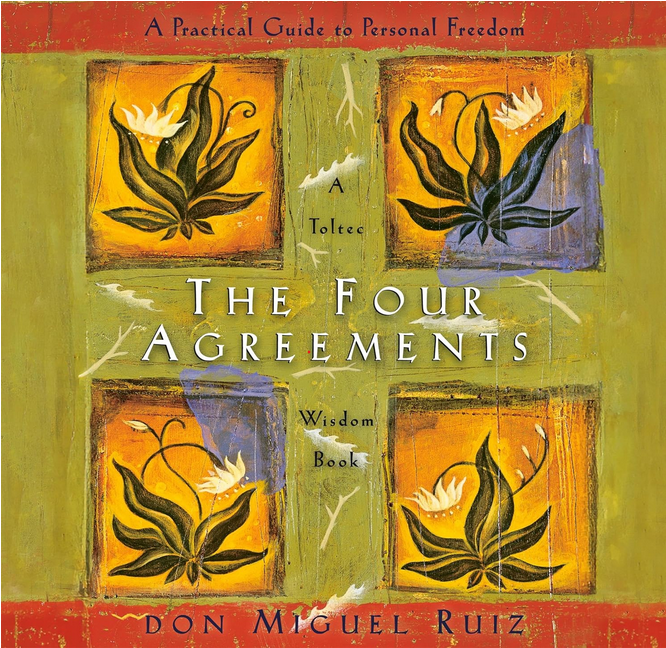
I wrote earlier about having read the book The Four Agreements by Don Miguel Ruiz and outlining the Four Agreements at the heart of that book:
- Be impeccable with your word.
- Don’t take anything personally.
- Don’t make assumptions.
- Always do your best.
I want to write about each of these, and have decided to go backwards through this list. So, I will start with the Agreement “Always do your best.”.
I am concerned about clear communication, context, and meaning. That concern makes this Agreement challenging. Here are a couple of the challenges:
- Consensus on the meaning of certain words like “best” and “always“.
- The overall effect of this Agreement on mindfulness and sense of self.
First, the meaning of words. I have written on this blog a lot about the difficulty of agreeing on the shared meaning of a word. Sometimes, in the context of a conversation, you can use a generic definition of, say, “car”, if that vagueness will work in the context of the conversation. However, if the kind of car and the context of its ownership, condition, etc. is what is driving the conversation, then you need to spend more time mutually defining the car. There is, of course, a big difference between a top-end 2026 Ferrari and an old, rusted-out, barely-functional 1961 Dodge Dart, so you need to agree on what the car is.
So, in the context of this Agreement, what does “best” mean? Well, what ISN’T it? It is not a line or standard set by someone else. There may be goals or metrics that you’re presented with towards which you or your team aspire, but they do not define your best. “Best” is a movable beast. You are an organic being, and there are a huge number of factors and conditions that moderate what is your “best” in every moment. Only you can know what your best is at any given time.
For example, I have certain disciplines I work very hard at, including walking. For a number of reasons, I tend to walk on our heavy-duty treadmill in 2-hour stretches at 2.4 miles per hour. I do this 3 days a week. There are days I have scheduled walks that can only go an hour, or weeks where I can only walk 1 or 2 days that week, and sometimes 4 days a week. Any more than that per week, for me, actually hurts me more than helps. I have discovered my “best” through trial and error, and it remains a moving target. Some days I’m not feeling well, so I either move the day that I’m going to walk, or, if my schedule doesn’t permit, I have to cancel that one. But, THAT is my “best” for that day and for that week. The thing that I can’t do is blame myself for not making this goal. I am doing my best. Taking the day off on that day is my best, especially when I consider one of the things I work at is learning to listen to my body. Best is Best.
The overall effect of this Agreement is to help me understand my own sense of being in every moment and know what is the right thing to do, and if I can’t do it, or fail doing it in some way, I am still doing my best in that moment! As I keep expanding in mindfulness, I can more clearly see what my “best” is in that moment. And I can follow that awareness into the next moment (and the next, etc….) so when I am presented with the next bit of life, I can know more clearly what “best” is or looks like.
If I mess things up, to the degree possible, I move past that assessment and work on the “Best” in the next moment. Mistakes are great for learning, but obsessing after the fact only minimizes the mindfulness of the moment I’m in NOW, making it more difficult to get to my current “best”.
One of the most important things I’ve learned from this Agreement is that acting on my best means never having to “fall on my sword” if I don’t hit some arbitrary target or disappoint someone. Best is Best. Goals are kind of imaginary, and someone else’s reaction to my best in any moment is not something I can control and not really my problem. I have no idea what the inner life of another is like, what they are demanding of themselves, their context, etc. Their reaction to me is their inner event, not mine. I’ll write more about this when I post on Agreement #2 – Don’t take anything personally. For now, rest and take comfort in hitting your best in every moment. Only you know what that is. Pay attention to it. Like now…