How Can Responsiveness Keep You Out of Trouble?

[fusion_builder_container hundred_percent=”yes” overflow=”visible”][fusion_builder_row][fusion_builder_column type=”1_1″ background_position=”left top” background_color=”” border_size=”” border_color=”” border_style=”solid” spacing=”yes” background_image=”” background_repeat=”no-repeat” padding=”” margin_top=”0px” margin_bottom=”0px” class=”” id=”” animation_type=”” animation_speed=”0.3″ animation_direction=”left” hide_on_mobile=”no” center_content=”no” min_height=”none”]

Facebook Business Responsiveness

Facebook Business Responsiveness

Responsiveness is critical to customer experience. If you get an email or see a post to your company Facebook page with a request or comment from a customer (or potential customer…), letting it go for awhile (or altogether…) is a recipe for TROUBLE! The speed by which you respond not only convinces that person that you’re listening, but that you actually care what they are bringing to you. However, there’s a lot more to this than speed…

How you respond and your tone prove how you treat this as an opportunity. You can not only build a better relationship with this person, but provide an online record of how professional and customer-centric your company is. I’ve written a lot about your VACC (Visitors/Audience/Customers/Community) and how your conversation with each differs and builds toward the kind of relationship that benefits all parties. Defined as “fair exchange“, this is a great relationship, as both parties derive immense value from the framework, and all work done on it only serves to strengthen it. The stronger the foundation, the easier it can be to get past the niceties of the regular communications and unveil greater authenticity and transparency. This is particularly true of bad news you need to deliver.

Continue reading

Best of November: TOP POSTS – No Turkeys Here!

Can you believe it? Thanksgiving is past and we are all on the short countdown to Christmas!? Well, while you were trying to finish off the Halloween candy AND putting together the grocery list for Thanksgiving, there have been a LOT of article published that deserve your attention…..I’ve gone through them and cherry-picked the most relevant ones for you!

[fusion_builder_container hundred_percent=”yes” overflow=”visible”][fusion_builder_row][fusion_builder_column type=”1_1″ background_position=”left top” background_color=”” border_size=”” border_color=”” border_style=”solid” spacing=”yes” background_image=”” background_repeat=”no-repeat” padding=”” margin_top=”0px” margin_bottom=”0px” class=”” id=”” animation_type=”” animation_speed=”0.3″ animation_direction=”left” hide_on_mobile=”no” center_content=”no” min_height=”none”]

Fall Reading List

Fall Reading List

One of my favorite sites to read, Conversation Agent by Valeria Maltoni, posted the seasonal reading list. I know your reading list is already pretty long, as is mine, but her recommendations always lead to revisit and lengthen mine. I’m sure this list will do the same for you!

Continue reading

What’s the Best Social Media Channel for my Business?

[fusion_builder_container hundred_percent=”yes” overflow=”visible”][fusion_builder_row][fusion_builder_column type=”1_1″ background_position=”left top” background_color=”” border_size=”” border_color=”” border_style=”solid” spacing=”yes” background_image=”” background_repeat=”no-repeat” padding=”” margin_top=”0px” margin_bottom=”0px” class=”” id=”” animation_type=”” animation_speed=”0.3″ animation_direction=”left” hide_on_mobile=”no” center_content=”no” min_height=”none”]

Which Social Media Channels?

Which Social Media Channels?

A small business owner asked me this question recently: Does it matter which social media channels my business focuses on?

This is a great question!
It does matter from a couple of angles:
  • You need to be where your customers are.
  • Focus is crucial, since each additional channel requires resources.
Let me elaborate….

Continue reading

OPEN UP: Do You Short Circuit A Valuable Conversation?

[fusion_builder_container hundred_percent=”yes” overflow=”visible”][fusion_builder_row][fusion_builder_column type=”1_1″ background_position=”left top” background_color=”” border_size=”” border_color=”” border_style=”solid” spacing=”yes” background_image=”” background_repeat=”no-repeat” padding=”” margin_top=”0px” margin_bottom=”0px” class=”” id=”” animation_type=”” animation_speed=”0.3″ animation_direction=”left” hide_on_mobile=”no” center_content=”no” min_height=”none”]

Angry Meme

Wrong Kind of Meme

Like many Americans, I have begun paying a lot closer attention to “the news” online in the run-up to the election this week. I have chosen to visit The Guardian (US. Edition) as a primary news site, since they are globally known as a credible news source and run articles ASIDE FROM ELECTION NEWS, which is a bit of a breather from US – based news organizations. Even their view of our election offers some deeper articles about the tides that effect both sides and all constituencies here, which is refreshing and gets me to think….always a good thing!

They published an article this past week entitled “Meme warfare: how the power of mass replication has poisoned the US election.”  In this article Douglas Haddow writes a bit about the evolution of memes on the Internet and how they have evolved. He notes that they can be fun, stupid and/or infuriating. What they are NOT is helpful in developing debate or conversation. Here is his definition of memes (so we can all know what exactly we’re thinking about here…):

“Memes – from the Greek for “that which is imitated” – were once defined as being self-replicating units of culture. This included anything that could be learned, remembered and spread from one brain to another, such as the concept of god all the way to the popular Budweiser “ Wazzup” catchphrase.
 
Through the Internet  the idea moved from the conceptual sphere into the viscous reality of data and pixels, transforming it into something more traceable: a segment of media that is copied rapidly. This includes images, text, video, a combination of all three and sometimes real-world actions.”

Continue reading

TOP POSTS for October – Crammed with Proven Treats!

[fusion_builder_container hundred_percent=”yes” overflow=”visible”][fusion_builder_row][fusion_builder_column type=”1_1″ background_position=”left top” background_color=”” border_size=”” border_color=”” border_style=”solid” spacing=”yes” background_image=”” background_repeat=”no-repeat” padding=”” margin_top=”0px” margin_bottom=”0px” class=”” id=”” animation_type=”” animation_speed=”0.3″ animation_direction=”left” hide_on_mobile=”no” center_content=”no” min_height=”none”][fusion_text]

With October comes the oncoming onslaught of the Holidays! This brings into focus how to get the most out of your social media and digital marketing so your business can go seriously into the BLACK for the season. The top articles for the month cover everything from SEO to Facebook Referrals and, in the season of BUYING AND SELLING, whether caring really matters.
Optimize Video

Optimize Video

Unless you haven’t been online in the past, oh, ten years or so, you are aware of just how popular to users and critical to businesses video is now. There is much more to leveraging video for you business than a quick snippet taken from your phone or a flash report on Facebook Live. Since video is so pervasive, you need to optimize your content….and one size does NOT fit every channel!

Continue reading

FOCUS: Does It Really Matter If You Care?

[fusion_builder_container hundred_percent=”yes” overflow=”visible”][fusion_builder_row][fusion_builder_column type=”1_1″ background_position=”left top” background_color=”” border_size=”” border_color=”” border_style=”solid” spacing=”yes” background_image=”” background_repeat=”no-repeat” padding=”” margin_top=”0px” margin_bottom=”0px” class=”” id=”” animation_type=”” animation_speed=”0.3″ animation_direction=”left” hide_on_mobile=”no” center_content=”no” min_height=”none”]

Caring

Caring

Caring is “we” not “I.”

In life and business, caring is the assessment that you have the other persons’ interests in mind as well as your own when you make decisions and take actions. Of the four aspects of trust I’ve written about, this is in many ways the most important. Others may believe you to be sincere, reliable, and competent, but if they believe you’re “only in it for yourself”, they will limit their trust of you to specific situations or transactions.  They will not fully TRUST you….

A state of limited trust can infect the other areas of trust. If others feel you don’t care, they begin to doubt your reliability, sincerity and competence. At the very best, they put conditions on trusting you. This will not deepen or strengthen your relationships with anyone.

It leads to this kind of thinking:
  • I may be able to believe what she says
  • She may do what she commits to
  • She may be competent
But…
  • I’m not going to trust her to do anything beyond the exact thing we’re working on right now.
  • I won’t let her get close to me or know what I’m thinking.
  • I’m not sharing ANYTHING about what I care about with her.

Continue reading

FOCUS: Is Your Competence “Fake It ’til You Make It”!?

[fusion_builder_container hundred_percent=”yes” overflow=”visible”][fusion_builder_row][fusion_builder_column type=”1_1″ background_position=”left top” background_color=”” border_size=”” border_color=”” border_style=”solid” spacing=”yes” background_image=”” background_repeat=”no-repeat” padding=”” margin_top=”0px” margin_bottom=”0px” class=”” id=”” animation_type=”” animation_speed=”0.3″ animation_direction=”left” hide_on_mobile=”no” center_content=”no” min_height=”none”]

competence

Competence

What kind of reality do you live in?

This is more than a philosophical or existential question, reaching past any famous figures “Reality Distortion Field” or the stories we tell ourselves, good or bad. As regards our true competence, the role we fill in our business lives, it is more about the difference between APPEARING competent and our ACTUAL competence. Wanting to display ourselves as knowledgeable, “Fake it ’til you Make it!” can get you into big trouble.

Feltman defines competence as, “the assessment that you have the ability to do what you are doing or propose to do. In the workplace this usually means the other person believe you have the requisite capacity, skill, knowledge, resources and time to do a particular task or job.”

Sometimes we have to battle the “brightness effect.” This causes others to believe that since you are associated with competence in one area, you are also competent in another area. I experienced this a lot when I worked for Microsoft. Many I know (a LOT of family members…..) assumed that, since I worked at Microsoft, I could fix whatever was wrong with their computers. Granted, I lived in a PC-centric world for many years, but that didn’t turn me into a computer engineer any more than standing in your garage turns you into a car! An example of this in business is a high-performance individual who is promoted into a management position. As many of you know, managing others is likely a COMPLETELY DIFFERENT SKILL from whatever the individual specialized in. The best you can do is be clear about what you know you can do, and what you have yet to learn. Then work with your management to get the resources to better your chances of success in your new role. Try very hard not to let them get away with “just figure it out.” Your success and the success of your team hinge on your becoming better.


Continue reading

AUGUST SAMPLER: 5 Informative and Imaginative Posts For You!

The end of summer is upon us. These diverse articles will tickle your imagination and start you thinking about what your autumn online activities might be!

10 Social Media Myths

10 Social Media Myths

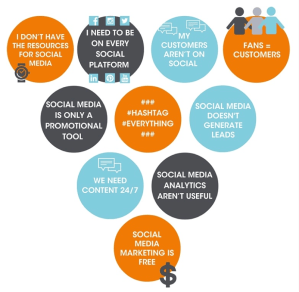
 Many times I must slip into “Mythbusters” Mode when speaking to groups about what’s real, what’s imaginary, and what’s merely perceived when it comes to social media. These 10 myths are not comprehensive, but they do cover many of the common misperceptions. If you have more questions, let me know!

Continue reading

FOCUS: Are They Twist Ties or Trust Ties?

Trust

Trust is more than a High Five!

Building trust is vital and required.
If you aren’t found to be trustworthy, that pretty much puts the end to having the kind of impact you want to have, whether personally or in business. While the same goes for those around you, you are the only one that can work on your own trustworthiness.

This week I read another mind-provoking article by Valeria Maltoni entitled “What Do We Do About Trust?”.  This led me to get a copy of a book mentioned in the article, The Thin Book of Trust by Charles Feltman, which I devoured in a couple hours. If you have a couple of hours (plane trip, hot afternoon on the patio, etc.) I recommend this. It is relatively short, very well written and focused on the topic in a way that you can absorb and use.

I am utterly fascinated by all of the relationship, network, cognitive and behavioral topics that surround us as human beings in our society and how they influence and guide our businesses and personal lives. Whether psychological studies into why we act the ways we do as they apply and “infect” other areas of study (like Behavioral Economics…how this influences how we actually make choices, both as business owners and consumers, and being aware of the WHY of these actions), to the kinds of thought and work that can make your business more effective, including marketing, VACC (Visitors/Audience/Customers/Community) and content research/strategies, along with the kinds of cognitive bias that keep us from being as successful and happy (…frankly…) as we can be. Much like the world of physics crawling toward The Grand Unifying Theory of Everything (not to be confused with the Answer to the Ultimate Question of Life, the Universe, and Everything…), I feel there are a lot of overlaps and supporting science and studies that lead to A Grand Unifying Theory of How We Actually Think and Get Along.

Continue reading

GO DEEP: Strong & Weak Ties – Your Genuine Challenge?

Strong Ties and Weak Ties

Strong Ties and Weak Ties

Once upon a time, there were “Strong Ties” and “Weak Ties” in business.

Strong Ties existed between you and your best customers. You interacted frequently and knew each other well. The bulk of your business was from and through these Strong Ties. It took some work. Maintaining them required a big investment of time and effort, but the benefits of business, the sharing of high-quality information, and the transfer of complex or “hidden” industry knowledge was well worth the effort.

Weak Ties were…well…weak. However, over time there was a declining ROI of time and effort in a network based on mostly Strong Ties. Weak Ties exposed you (and the Ties) to a broader span of knowledge, expertise and opportunity. Exposure to more diverse information and resources has been shown to drive higher rates of radical innovation, and be especially useful when you have a tough problem to crack.

How things stand today?
It’s complicated…
First, there are roughly 2 billion social media users in the world.

Billion…..with a B.

Second, according to McKinsey Global Institute, at least 70% of companies are using some form of social media. Online search and social media sites have increasingly become the primary, if not sole, source of information for individuals and businesses alike.  These have largely displaced traditional sources such as printed company literature, the Yellow Pages and business directories. Organizations no longer have control over what is disseminated about them. As one publication states, “most of what is said about the company will not be said by the company” (AT&T, 2011). In a recent global consumer survey by BrightLocal, 88% of respondents said that they place greater trust in other people’s online recommendations for products and services than in other sources. The significance of this is reflected in the growing popularity of consumer websites based almost entirely on personal reviews, such as TripAdvisor and Yelp, and the dominant role of consumer reviews on leading e-commerce sites such as Amazon, eBay, and Facebook Business pages.

OK, so Weak Ties are becoming more important, Strong Ties are evolving, and you have a business to run. What does this mean that you do?

  • You need to develop new relationship-based associations with your customers and other social media participants (All Ties…), especially to build and maintain brand loyalty and to manage or at least influence what is being said about you online. Instead of just disseminating information about the organization and its products, you need to actively participate in the discussions on social media sites and develop other methods to engage Internet users. Most people deal with information overload when surfing the Web or visiting social media sites, so you need to design and implement content and initiatives that are interesting, entertaining or thought-provoking, to capture and hold their attention.
  • You will also be judged by the way in which you respond to online customer feedback, especially negative comments or complaints. Your reputation is on the line here, since everyone on the Internet can observe the interaction and judge accordingly. You need to develop and maintain not just a brand but an online personality which is likeable and well-respected and with which individuals can develop a real sense of familiarity and emotional connection. It is now often argued that ROI on marketing should now be measured not in traditional sales terms, but in terms of “return on engagement”. What is important is a measurement of engagement or emotional investment in the brand, such as active participation on the company website or favorable references to it in blog posts. These not only translate into longer-term individual loyalty but also help to attract additional followers who may become fans and customers.
  • Key in both the B2B and the B2C social media contexts is the ability to identify and build relationships with “key influencers” in the business network or target market. Jay Baer writes about this topic regularly with keen insight. This observation returns us neatly to the concept of social networks and the concept of weak and strong ties. In order to achieve the desired business objectives, there is a need to plumb the mass of online users and identify those likely to have the greatest impact. Within social networks, for example, there are usually key individuals or “trusted experts” who have established a strong reputation in their field. You need to make positive connections with a few key influencers who will transmit positive information about you. This is likely to be much more effective a strategy, and much less resource-intensive, than direct relationship-building with large numbers of people in the target market. Similarly, when a business partner or expert is needed, it can be invaluable to locate and build a relationship first with a “critical enabler” or “trusted advisor” who can offer not only detailed knowledge of the relevant industry niche and its participants, but who also knows the key decision makers personally and can help arrange an introduction or advise on the best approach to them. The old saying, “It’s not what you know but who you know” applies.
  • Curtis & Lewis (2010) argue that in order to develop effective relationships with key enablers or other stakeholders, the principle of progressive reciprocity should be followed, in which something of value is offered to the other party at the outset, not just after an offer of help is secured. You might benefit from developing and maintaining strong ties with key influencers or critical enablers who are likely to provide ongoing value and benefits in return. At the same time, you should maintain a wider network of weak ties with other stakeholders who hold relevant knowledge, expertise or market influence. One strategy that is likely to be effective across the board is to establish the your company itself, or individuals within it, as trusted experts in a particular subject area, for example by publishing well-researched, informative articles or blog posts on relevant topics.
Business relationships in the early 21st century have become much less binary and much more fuzzy. Your opportunity here is to establish a bit of order out of the seeming chaos online, think differently about relationship-building and your VACC (Visitors/Audience/Customers/Community), and realize the untapped potential for explosive business growth this presents to you.

Go on……we’re waiting to hear from you!