OPEN UP: Do You Short Circuit A Valuable Conversation?

[fusion_builder_container hundred_percent=”yes” overflow=”visible”][fusion_builder_row][fusion_builder_column type=”1_1″ background_position=”left top” background_color=”” border_size=”” border_color=”” border_style=”solid” spacing=”yes” background_image=”” background_repeat=”no-repeat” padding=”” margin_top=”0px” margin_bottom=”0px” class=”” id=”” animation_type=”” animation_speed=”0.3″ animation_direction=”left” hide_on_mobile=”no” center_content=”no” min_height=”none”]

Angry Meme

Wrong Kind of Meme

Like many Americans, I have begun paying a lot closer attention to “the news” online in the run-up to the election this week. I have chosen to visit The Guardian (US. Edition) as a primary news site, since they are globally known as a credible news source and run articles ASIDE FROM ELECTION NEWS, which is a bit of a breather from US – based news organizations. Even their view of our election offers some deeper articles about the tides that effect both sides and all constituencies here, which is refreshing and gets me to think….always a good thing!

They published an article this past week entitled “Meme warfare: how the power of mass replication has poisoned the US election.”  In this article Douglas Haddow writes a bit about the evolution of memes on the Internet and how they have evolved. He notes that they can be fun, stupid and/or infuriating. What they are NOT is helpful in developing debate or conversation. Here is his definition of memes (so we can all know what exactly we’re thinking about here…):

“Memes – from the Greek for “that which is imitated” – were once defined as being self-replicating units of culture. This included anything that could be learned, remembered and spread from one brain to another, such as the concept of god all the way to the popular Budweiser “ Wazzup” catchphrase.
 
Through the Internet  the idea moved from the conceptual sphere into the viscous reality of data and pixels, transforming it into something more traceable: a segment of media that is copied rapidly. This includes images, text, video, a combination of all three and sometimes real-world actions.”

Continue reading

TOP POSTS for October – Crammed with Proven Treats!

[fusion_builder_container hundred_percent=”yes” overflow=”visible”][fusion_builder_row][fusion_builder_column type=”1_1″ background_position=”left top” background_color=”” border_size=”” border_color=”” border_style=”solid” spacing=”yes” background_image=”” background_repeat=”no-repeat” padding=”” margin_top=”0px” margin_bottom=”0px” class=”” id=”” animation_type=”” animation_speed=”0.3″ animation_direction=”left” hide_on_mobile=”no” center_content=”no” min_height=”none”][fusion_text]

With October comes the oncoming onslaught of the Holidays! This brings into focus how to get the most out of your social media and digital marketing so your business can go seriously into the BLACK for the season. The top articles for the month cover everything from SEO to Facebook Referrals and, in the season of BUYING AND SELLING, whether caring really matters.
Optimize Video

Optimize Video

Unless you haven’t been online in the past, oh, ten years or so, you are aware of just how popular to users and critical to businesses video is now. There is much more to leveraging video for you business than a quick snippet taken from your phone or a flash report on Facebook Live. Since video is so pervasive, you need to optimize your content….and one size does NOT fit every channel!

Continue reading

How Do You Focus To Listen?

[fusion_builder_container hundred_percent=”yes” overflow=”visible”][fusion_builder_row][fusion_builder_column type=”1_1″ background_position=”left top” background_color=”” border_size=”” border_color=”” border_style=”solid” spacing=”yes” background_image=”” background_repeat=”no-repeat” padding=”” margin_top=”0px” margin_bottom=”0px” class=”” id=”” animation_type=”” animation_speed=”0.3″ animation_direction=”left” hide_on_mobile=”no” center_content=”no” min_height=”none”]

Listen-To-Understand

Listen-To-Understand

There is a budding resurgence taking place concerning the importance of Conversation in life and business. Not that a lot of the words aren’t just hanging out there, dissipating in the wind. A lot of businesses grab the “shiny thing” when it comes to the latest discussions and thinking around whatever can keep us growing, or at least “safe.” I still experience an enormous amount of Telling and Broadcasting instead of Conversation and Engagement, both online and off-line. Even conversation has numerous forks in the concept, the largest two seem to be “listening-to-reply” and “listening-to-understand.”
A few years ago I wrote an article about the abundance of LIKING-type behavior online in comparison to the actual conversation taking place. Businesses were still trying to figure out this new paradigm where the customers actually controlled the brand perceptions, and NOT the BRAND controlling them. Along with the immature capabilities for measuring real engagement and the misunderstanding surrounding the actual meaning and value of a LIKE or a FOLLOW or a “+1” meant that the definitions of success were too fuzzy, and likely incorrect.
Things are different now.

Continue reading

FOCUS: Is Your Competence “Fake It ’til You Make It”!?

[fusion_builder_container hundred_percent=”yes” overflow=”visible”][fusion_builder_row][fusion_builder_column type=”1_1″ background_position=”left top” background_color=”” border_size=”” border_color=”” border_style=”solid” spacing=”yes” background_image=”” background_repeat=”no-repeat” padding=”” margin_top=”0px” margin_bottom=”0px” class=”” id=”” animation_type=”” animation_speed=”0.3″ animation_direction=”left” hide_on_mobile=”no” center_content=”no” min_height=”none”]

competence

Competence

What kind of reality do you live in?

This is more than a philosophical or existential question, reaching past any famous figures “Reality Distortion Field” or the stories we tell ourselves, good or bad. As regards our true competence, the role we fill in our business lives, it is more about the difference between APPEARING competent and our ACTUAL competence. Wanting to display ourselves as knowledgeable, “Fake it ’til you Make it!” can get you into big trouble.

Feltman defines competence as, “the assessment that you have the ability to do what you are doing or propose to do. In the workplace this usually means the other person believe you have the requisite capacity, skill, knowledge, resources and time to do a particular task or job.”

Sometimes we have to battle the “brightness effect.” This causes others to believe that since you are associated with competence in one area, you are also competent in another area. I experienced this a lot when I worked for Microsoft. Many I know (a LOT of family members…..) assumed that, since I worked at Microsoft, I could fix whatever was wrong with their computers. Granted, I lived in a PC-centric world for many years, but that didn’t turn me into a computer engineer any more than standing in your garage turns you into a car! An example of this in business is a high-performance individual who is promoted into a management position. As many of you know, managing others is likely a COMPLETELY DIFFERENT SKILL from whatever the individual specialized in. The best you can do is be clear about what you know you can do, and what you have yet to learn. Then work with your management to get the resources to better your chances of success in your new role. Try very hard not to let them get away with “just figure it out.” Your success and the success of your team hinge on your becoming better.


Continue reading

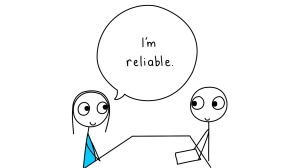
FOCUS: Of Course You’re Reliable! RIGHT??

Are you Reliable?

Are you Reliable?

The far end of reliability is taking things for granted, right?

You hop in your car, perform some kind of ignition action, and you just EXPECT the car to start up so you can go do what you need to do. You head into the barbershop or salon you’ve been frequenting for awhile, sit down for some kind of hair-related operation (maybe with the same barber or stylist you’ve been seeing the whole time…) and EXPECT to look a certain way when you leave. You flip a light switch in your living room and you EXPECT a light of some sort to go on.

It’s when you perform these actions and what you expected DOESN’T happen that you become intensely aware of reliability.

Each of these examples involves an inanimate object, but the same expectations and certainty are what define reliability in relationships as you build trust. In his book on trust, Charles Feltman defines reliability as “the assessment that you meet the commitments you make, that you keep your promises.” You make commitments in two ways: in response to someone else’s request (or, if they’re higher up the food chain than you are, it might be a direction or command…) OR by making an offer to someone. When the other persons accepts your offer they usually consider it a commitment on your part.

Requests can be the problem. Crystal clear communication is crucial here, because if you don’t have all the information you need AND you walk away with the request, the requester will assume you’ve committed to do exactly what they asked…..only you won’t be clear on the specifics, so you chances of success are, shall we say, variable. Sadly, many requests are the only-slightly-less-generic version “go do stuff with that thing and get back to me whenever…”

YIKES!
Feltman writes that you can increase real reliability through what he calls The Cycle of Commitment – basic elements that make for clear, complete, and direct requests:

  • CUSTOMER – Who’s doing the asking here? Who’s the request actually FOR? Never assume anything that looks obvious, here. When someone says something like, “We need to do some research on this” you desperately need to know who the research is for, so you can get to specific expectations about the research and also know to whom you go for further clarification or if you have concerns.
  • PERFORMER – Who’s going to do the work? Is it you? Are you qualified? Do you have the resources (time, talent, funds…) to fulfill the request? Is that clear to you AND to the requester?
  • ACTION – Just what EXACTLY does the customer want you to do? Can you actually do it? What measurements for the action or deliverables will be the outcomes of this action?
  • TIMEFRAME – When does the customer want it to be completed….Oh, and ASAP is not at all helpful.  Get a solid date, since ASAP may mean by the end of the week to you and by the end of the day to the customer.
Make sure you have complete clarity on each of these elements and your chance at success AND demonstrated reliability are significantly enhanced.

So, that’s what it looks like when others are making requests of you, but how can you help others by making your requests more effective?

Be Direct. Direct requests have a much better chance of clarity than indirect requests. Many people often “soften” their requests (making them indirect in a way…) because they feel that direct requests are impolite in some way. Granted, different cultures have different standards and mores surrounding the acceptable kinds of language used in making direct requests, so you need to be aware of that factor, however, what appears to work best in what I will call “typical” European and North American cultures, what seems to work best include the phrases:
  • I ask that you…
  • I request
  • Will you (please)…
  • (Please) do this….
 Less direct request, which are less clear and therefore less direct, include the phrases:
  • I want or I need…
  • Why don’t you…
  • …needs to be done.
 None of these is a real request, but most understand the intention.

Ridiculously indirect requests, which are usually not even perceived as requests, can include phrases like:
  • My coffee cup is empty. (Secret request: Get me more coffee.)
  • The conference room is a disaster. (Secret request: Clean up the conference room.)
  • It’s almost eleven o’clock. (Secret request: Get me the printed slides for the 11:00 team meeting.)
See how helpful being very indirect ISN’T?!

Of course, how you respond to a request is just as important as getting the request right if you’re demonstrating reliability. Once the Customer makes the request, the Performer (you, in this case…) need to respond. Here are the possible responses:

  • COMMIT – “Yes, I’ll do it.” To them this means, “I will do exactly what you’ve asked me to do. Here is where real clarity about the request is critical. If the request is vague or missing information, it is up to you to ask for it.
  • DECLINE – “No, I can’t (or won’t) do it.” This let’s the customer that you aren’t available to do whatever she’s requesting…..she needs to find a different resource. Sadly, in the workplace, many times “No” isn’t an option….however, saying “Yes” is truly setting yourself up for failure, so consider how “No” could be framed.
  • COUNTEROFFER – “I can’t do that, but instead I can do…” This is one way “No” in the workplace could be framed. Create something that MIGHT work. A counteroffer opens a negotiation scenario between you and the customer. This should end in either a commitment or a declination. Leaving things hanging in midair is the same as failure.
  • COMMIT-TO-COMMIT – “I need to check on something (resources, time, etc.) before I can get you an answer. I’ll get back to you by…” You might need more information. Regardless of the reason, be sure to designate a time at which they WILL get a firm answer.
Lastly, there’s the old favorite, the Drive-By Request. Seen mostly in offices, this type of request is the most easily tossed-off and the most likely to fail.

I remember vividly chasing my manager down the hall pleading for more information and clarification as she receded into a conference room and shut the door. As many of these requests are, it was a “short-fuse” request and I could either wait for her to return to her office AND lose precious time, or get hot on the request and HOPE that I hit at least SOME of the actual target. I usually did the latter and paid for it painfully. So, You can live with the stress of unclear deliverables or the stress of waiting for clarification so that success will be more likely. If possible, get together with this customer and go over the Cycle of Commitment with her…..for example, ask her not to assume “Yes” to a Drive-By request. Instead, she should give you a chance to respond to the request and get all the particulars. Everyone involved is much more likely to be happy with the result.

So here are some ways build your reputation of reliability:

  • Make sure you can actually do what is asked of you BEFORE you respond to a request.
  • If the request is unclear, ask for clarification and any missing bits of information.
  • If you are offering to do something, be sure they understand what you CAN and CANNOT do.
  • Listen to people to determine if they are making EXTREMELY indirect requests of you. Are they just talking, or are they creating a framework of expectations that are clear to them and vague to you? Decide which it is, and respond.
Reliability is more than just consistency. I know people who consistently make questionable choices…..that’s not the kind of reliable I’m looking for!

FOCUS: Are They Twist Ties or Trust Ties?

Trust

Trust is more than a High Five!

Building trust is vital and required.
If you aren’t found to be trustworthy, that pretty much puts the end to having the kind of impact you want to have, whether personally or in business. While the same goes for those around you, you are the only one that can work on your own trustworthiness.

This week I read another mind-provoking article by Valeria Maltoni entitled “What Do We Do About Trust?”.  This led me to get a copy of a book mentioned in the article, The Thin Book of Trust by Charles Feltman, which I devoured in a couple hours. If you have a couple of hours (plane trip, hot afternoon on the patio, etc.) I recommend this. It is relatively short, very well written and focused on the topic in a way that you can absorb and use.

I am utterly fascinated by all of the relationship, network, cognitive and behavioral topics that surround us as human beings in our society and how they influence and guide our businesses and personal lives. Whether psychological studies into why we act the ways we do as they apply and “infect” other areas of study (like Behavioral Economics…how this influences how we actually make choices, both as business owners and consumers, and being aware of the WHY of these actions), to the kinds of thought and work that can make your business more effective, including marketing, VACC (Visitors/Audience/Customers/Community) and content research/strategies, along with the kinds of cognitive bias that keep us from being as successful and happy (…frankly…) as we can be. Much like the world of physics crawling toward The Grand Unifying Theory of Everything (not to be confused with the Answer to the Ultimate Question of Life, the Universe, and Everything…), I feel there are a lot of overlaps and supporting science and studies that lead to A Grand Unifying Theory of How We Actually Think and Get Along.

Continue reading

GO DEEP: Strong & Weak Ties – Your Genuine Challenge?

Strong Ties and Weak Ties

Strong Ties and Weak Ties

Once upon a time, there were “Strong Ties” and “Weak Ties” in business.

Strong Ties existed between you and your best customers. You interacted frequently and knew each other well. The bulk of your business was from and through these Strong Ties. It took some work. Maintaining them required a big investment of time and effort, but the benefits of business, the sharing of high-quality information, and the transfer of complex or “hidden” industry knowledge was well worth the effort.

Weak Ties were…well…weak. However, over time there was a declining ROI of time and effort in a network based on mostly Strong Ties. Weak Ties exposed you (and the Ties) to a broader span of knowledge, expertise and opportunity. Exposure to more diverse information and resources has been shown to drive higher rates of radical innovation, and be especially useful when you have a tough problem to crack.

How things stand today?
It’s complicated…
First, there are roughly 2 billion social media users in the world.

Billion…..with a B.

Second, according to McKinsey Global Institute, at least 70% of companies are using some form of social media. Online search and social media sites have increasingly become the primary, if not sole, source of information for individuals and businesses alike.  These have largely displaced traditional sources such as printed company literature, the Yellow Pages and business directories. Organizations no longer have control over what is disseminated about them. As one publication states, “most of what is said about the company will not be said by the company” (AT&T, 2011). In a recent global consumer survey by BrightLocal, 88% of respondents said that they place greater trust in other people’s online recommendations for products and services than in other sources. The significance of this is reflected in the growing popularity of consumer websites based almost entirely on personal reviews, such as TripAdvisor and Yelp, and the dominant role of consumer reviews on leading e-commerce sites such as Amazon, eBay, and Facebook Business pages.

OK, so Weak Ties are becoming more important, Strong Ties are evolving, and you have a business to run. What does this mean that you do?

  • You need to develop new relationship-based associations with your customers and other social media participants (All Ties…), especially to build and maintain brand loyalty and to manage or at least influence what is being said about you online. Instead of just disseminating information about the organization and its products, you need to actively participate in the discussions on social media sites and develop other methods to engage Internet users. Most people deal with information overload when surfing the Web or visiting social media sites, so you need to design and implement content and initiatives that are interesting, entertaining or thought-provoking, to capture and hold their attention.
  • You will also be judged by the way in which you respond to online customer feedback, especially negative comments or complaints. Your reputation is on the line here, since everyone on the Internet can observe the interaction and judge accordingly. You need to develop and maintain not just a brand but an online personality which is likeable and well-respected and with which individuals can develop a real sense of familiarity and emotional connection. It is now often argued that ROI on marketing should now be measured not in traditional sales terms, but in terms of “return on engagement”. What is important is a measurement of engagement or emotional investment in the brand, such as active participation on the company website or favorable references to it in blog posts. These not only translate into longer-term individual loyalty but also help to attract additional followers who may become fans and customers.
  • Key in both the B2B and the B2C social media contexts is the ability to identify and build relationships with “key influencers” in the business network or target market. Jay Baer writes about this topic regularly with keen insight. This observation returns us neatly to the concept of social networks and the concept of weak and strong ties. In order to achieve the desired business objectives, there is a need to plumb the mass of online users and identify those likely to have the greatest impact. Within social networks, for example, there are usually key individuals or “trusted experts” who have established a strong reputation in their field. You need to make positive connections with a few key influencers who will transmit positive information about you. This is likely to be much more effective a strategy, and much less resource-intensive, than direct relationship-building with large numbers of people in the target market. Similarly, when a business partner or expert is needed, it can be invaluable to locate and build a relationship first with a “critical enabler” or “trusted advisor” who can offer not only detailed knowledge of the relevant industry niche and its participants, but who also knows the key decision makers personally and can help arrange an introduction or advise on the best approach to them. The old saying, “It’s not what you know but who you know” applies.
  • Curtis & Lewis (2010) argue that in order to develop effective relationships with key enablers or other stakeholders, the principle of progressive reciprocity should be followed, in which something of value is offered to the other party at the outset, not just after an offer of help is secured. You might benefit from developing and maintaining strong ties with key influencers or critical enablers who are likely to provide ongoing value and benefits in return. At the same time, you should maintain a wider network of weak ties with other stakeholders who hold relevant knowledge, expertise or market influence. One strategy that is likely to be effective across the board is to establish the your company itself, or individuals within it, as trusted experts in a particular subject area, for example by publishing well-researched, informative articles or blog posts on relevant topics.
Business relationships in the early 21st century have become much less binary and much more fuzzy. Your opportunity here is to establish a bit of order out of the seeming chaos online, think differently about relationship-building and your VACC (Visitors/Audience/Customers/Community), and realize the untapped potential for explosive business growth this presents to you.

Go on……we’re waiting to hear from you!

Top 5 Timely and Valuable Articles for July

Wow, that was fast!

There was all the hub-bub for the Fourth of July, then the flurry of political conventions, and now we’re at the end of the month and looking back at some of the really helpful articles that have been published across the web…..and there have been a LOT of them! Here are the top 5 I’ve read and know you will find useful:

Deleting your Social Media Biz Page

Throw it all away….or not?

You’ve tried every which way with Facebook and you’ve decided that the only way out is to delete the page altogether. Is this really a good idea? Are there any other options? This article by Brooke B. Sellas of B Squared Media will help you consider, and reconsider, this conundrum.

Continue reading

The 5 Top Tested and Approved Posts for June!

 Kicking off the summer months with some TERRIFIC material covering ROI, opportunity discovery and various views on reaching the right Visitors/Audience/Customers/Community (VACC) for your business.

Who's your audience?

Do you know your Audience?

 
Growing on Social Media doesn’t mean quadrupling the number of times you post. It requires study, research, strategy and an understanding of the important metrics that drive your business online. That’s a lot to ask of a small business owner….this article by Jay Shemenski outlines 5 steps toward identifying the opportunities for your company. If this looks like something you need help, give us a call.

Continue reading

How Much Do You Compromise Your Planning?

Compromising position

If you don’t see it, it’s still there….

Planning is not something that comes naturally to a lot of small-to-medium business (SMB) owners.

Oh, we’re pretty good at planning out our day’s work, maybe setting up appointments and some are even pretty good at prioritization and time management. When we started out, we might have even gotten some help, or at least a copy of a template and some instructions for someplace, and created an time that we pronounced as our “business plan”. We promptly placed it in a folder, slapped it into a drawer of some kind, and proceeded to find some customers and get some work so we could get the revenue going. Besides, the primary we founded this business was so we could do something that we’re REALLY GOOD at and enjoyed doing. “As long as I’ve got a good pipeline of customers, I’m good!” has been the thought from the beginning. And that’s NOT entirely wrong…..but…..

Continue reading